
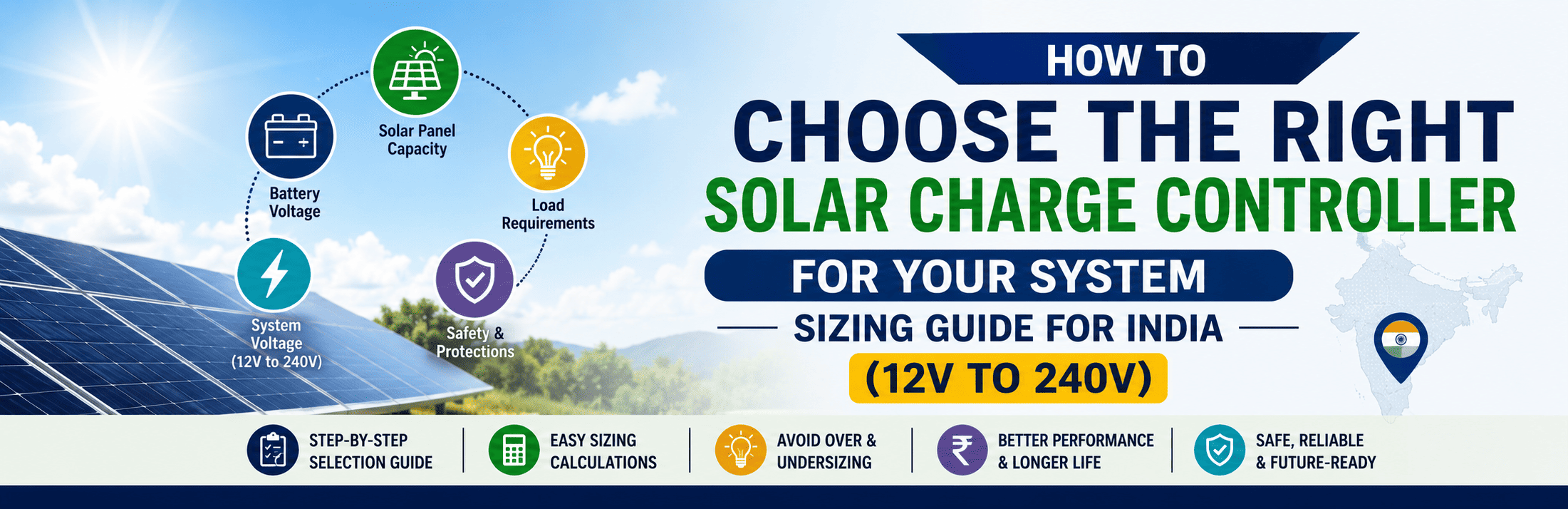
This guide will prevent that mistake. By the end of this 10-minute read, you will know exactly which Systellar charge controller to buy for your specific solar system — by amperage, voltage, and battery chemistry. We will show you the formula, walk through real Indian examples, and end with a single sizing table that matches any system to the right model.
- Know your battery bank voltage (12V / 24V / 48V / higher)
- Know your total solar panel wattage (sum of all panels)
- Know your battery chemistry (Lead Acid, Lithium-ion, LiFePO4)
- Jump to the complete sizing table → for your model
- Step 1: Identify your battery bank voltage
- Step 2: Calculate total solar panel wattage
- Step 3: Choose your charging current (amps)
- Step 4: Match your battery chemistry
- Step 5: Decide if you need extras (SMU, IoT, DC output)
- The complete Systellar sizing table
- 6 common sizing mistakes to avoid
- Frequently asked questions
- Ready to buy? Next steps
Step 1: Identify your battery bank voltage
Battery bank voltage is the single most important factor — get this wrong and the controller will not work at all. The good news: it is easy to check. Look at the nameplate on your battery (or batteries wired together) and find the voltage label, or use a multimeter set to DC volts across the battery terminals.
Common battery voltages in India:
| Voltage | Typical use | Systellar product family |
|---|---|---|
| 12V | Small home lighting, fans, single inverter | CC-HLS PWM / MPPT Compact-100 |
| 24V | Medium home / small shop / 1–3 kW system | MPPT Compact-100 / Compact-200 |
| 48V | Off-grid home / 3–8 kW / hybrid systems | MPPT Compact-200 / Gen6-200 |
| 72V – 240V | Petrol pumps, schools, institutes with existing HV inverters | CC-MPPT-HV / CC-PWM-HV |
Series vs parallel batteries: Two 12V batteries in series = 24V system. Four 12V batteries in series = 48V. Two 12V batteries in parallel = still 12V (just doubles the Ah capacity).
Step 2: Calculate your total solar panel wattage (Wp)
Add up the wattage of every solar panel in your array. A panel typically has a sticker with “Pmax” or “Maximum Power” rated in watt-peak (Wp).
For panels wired in series: Wp is the same, voltages add. For panels in parallel: Wp adds, voltage stays the same. Either way — add the wattages.
Example: 4 panels of 400W = 1,600W total. This is the number you use.
Charge controllers fail when the panel’s open-circuit voltage exceeds the controller’s maximum input. Voc is printed on the panel sticker. On cold Delhi mornings, real Voc can be 15% above the rated value. Always pick a controller whose maximum input voltage is at least 1.2× the panel’s rated Voc (in series). Systellar MPPT Compact-100 handles up to 100V Voc; Compact-200 and Gen6-200 handle up to 200V Voc.
Step 3: Choose your charging current (amps)
This is where most online guides give vague thumb-rules. Here is the exact formula:
The 1.25 is a safety factor for cold-weather voltage spikes and 25-year panel-life derating. Never skip it.
Worked examples
- 600W panels, 12V battery → 600 ÷ 12 × 1.25 = 62.5A → need 75A MPPT Gen6
- 600W panels, 24V battery → 600 ÷ 24 × 1.25 = 31.25A → 50A MPPT Compact
- 1,500W panels, 48V battery → 1,500 ÷ 48 × 1.25 = 39A → 50A MPPT Gen6
- 3,000W panels, 48V battery → 3,000 ÷ 48 × 1.25 = 78A → 75A MPPT Gen6 (or split into 2 controllers)
- 150W panels, 12V battery → 150 ÷ 12 × 1.25 = 15.6A → 25A MPPT Compact (or 20A PWM for tight budgets)
Step 4: Match your battery chemistry
Five battery types are common in Indian solar systems. Using the wrong charging profile damages the battery — sometimes within months.
| Battery type | Typical life | Charging notes |
|---|---|---|
| Lead Acid — Flat Plate | 3–4 years | Cheapest; needs 4-stage charging |
| Lead Acid — Tubular | 5–7 years | Common in home inverters; 4-stage |
| Lead Acid — Gel / SMF | 4–6 years | Maintenance-free; specific voltages |
| Lithium-ion | 7–10 years | Compact, lightweight; needs constant-voltage profile |
| LiFePO4 | 10–15 years | Safest, longest cycle life — recommended |
Systellar’s charge controllers are field-programmable for all 5 chemistries. You can change the battery type via LCD menu without buying new hardware — useful when you eventually upgrade from Lead Acid to LiFePO4.
Step 5: Decide if you need extras (SMU, IoT, DC output)
Three optional features that can transform your system:
🔄 Solar Management Unit (SMU)
SMU lets your existing home inverter automatically switch between grid and solar charging. You don’t need to buy a new “solar inverter” — your existing inverter becomes one. Only Systellar MPPT Gen6 has SMU built in at this price range. Game-changer for retrofit installations.
🔌 DC Output
If you run 12V DC loads — DC street lights, some water pumps, DC fans, garden lights — you need a controller with a built-in DC load output and timer. All Systellar MPPT models have DC output with programmable dusk-to-dawn timing.
The Complete Systellar Sizing Table
This is your one-stop reference. Match your system to a row and you have your answer:
| Battery V | Panel size | Charging A | Recommended model | Approx. price | Buy |
|---|---|---|---|---|---|
| 12V | up to 150W | 10A | CC-HLS 12V PWM | ₹500–₹1,500 | Buy |
| 12V / 24V | 150W–750W | 25A | MPPT Compact-100-25A | ₹4,500–₹8,000 | Buy |
| 12V / 24V | 750W–1,500W | 50A | MPPT Compact-100-50A | ₹7,500–₹12,000 | Buy |
| 12V – 48V | up to 1,500W | 25A | MPPT Compact-200-25A | ₹6,500–₹11,000 | Buy |
| 12V – 48V | 1,500W–3,000W | 50A | MPPT Compact-200-50A | ₹10,500–₹17,000 | Buy |
| 12V – 48V | 800W–3,200W | 50A + SMU | MPPT Gen6-200-50A | ₹14,500–₹22,000 | Buy |
| 12V – 48V | 1,200W–4,800W | 75A + SMU | MPPT Gen6-200-75A | ₹22,000–₹32,000 | Buy |
| 72V – 240V | 4.8 – 16 kW | 50A | CC-MPPT-HV-50A | ₹45,000–₹85,000 | Call |
| 72V – 240V (retrofit) | 1.8 – 6 kW | 20A | CC-PWM-HV-20A | ₹6,000–₹18,000 | Call |
| 48V – 240V (retrofit) | 2.4 – 12 kW | 40A | CC-PWM-HV-40A | ₹12,000–₹35,000 | Buy |
Prices are approximate, May 2026. Final pricing depends on configuration and order quantity. Bulk pricing available for orders of 10+ units.
6 Common Sizing Mistakes (Avoid These)
Result: Cold winter mornings push panel voltage above the controller’s limit. Controller burns out. How Systellar prevents this: Compact-200 and Gen6-200 handle up to 200V Voc — 30%+ headroom for any standard array.
Result: First cloudy week with an intense Vmp spike kills it. The 1.25 safety factor in our formula prevents this — always size up.
Result: Lead-acid charging profile on a LiFePO4 battery → battery dies in 6–12 months. How Systellar prevents this: field-programmable for all 5 chemistries via LCD menu.
Result: Indian summers cut PWM efficiency by 8–12%; non-thermal-protected controllers fail. How Systellar prevents this: every model tested to 60°C ambient, 95% humidity.
Result: Losing 30%+ of solar energy as heat. How Systellar prevents this: our buying guide above tells you exactly when MPPT is mandatory.
Result: First lightning strike → ₹50,000 of battery dead. How Systellar prevents this: every controller has PV, battery, and DC load surge protection built in.
Frequently Asked Questions
What size charge controller do I need for 500W solar panels?
What size charge controller for 1kW / 1000W solar panels?
What size for 2kW / 2000W solar?
What size charge controller for 5kW / 5000W solar?
Can I use a 30A controller with 1500W panels?
What happens if my charge controller is undersized?
Should I oversize my charge controller, and by how much?
Can I run two charge controllers in parallel?
Are Systellar charge controllers BIS or MNRE certified?
Where can I buy Systellar charge controllers online?
Ready to buy? Here’s your next step
If your system is unusual — very high voltage, large industrial scale, or you want a custom configuration — our engineers in Meerut will help you spec it correctly. We do not believe in selling you the most expensive product. We believe in selling you the right product.