
Solar Street Light in India — Complete Buying Guide 2026
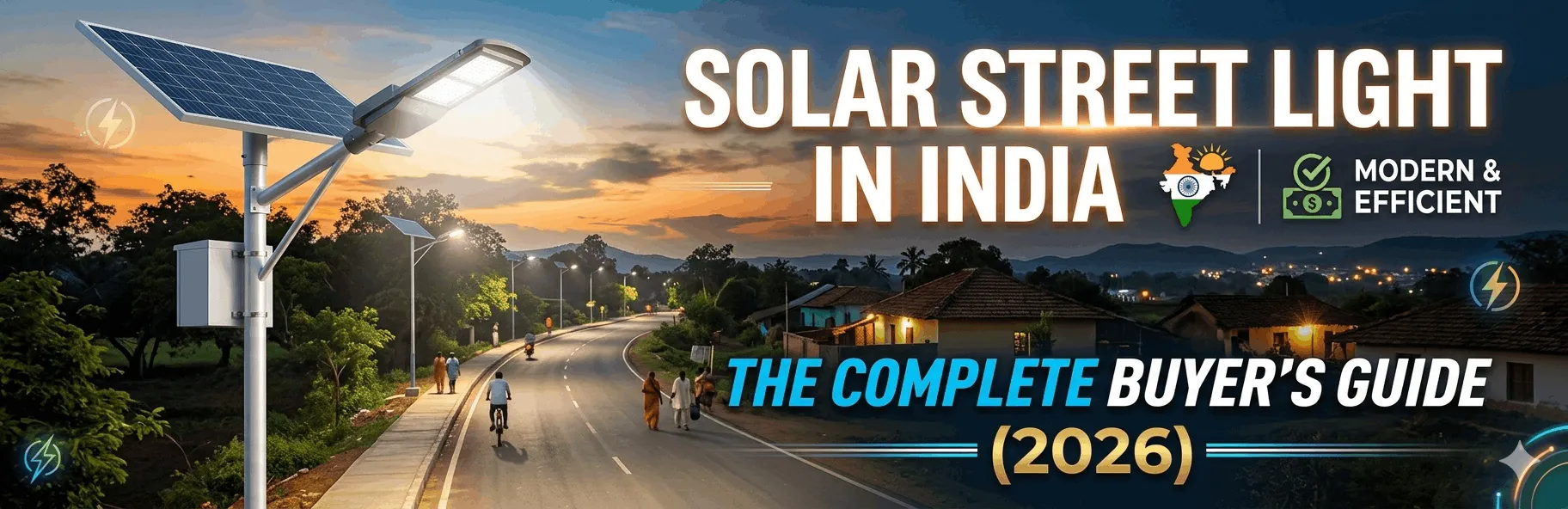
What this guide covers: A complete reference for anyone buying solar street lights in India — how they work, which type suits your project, how to pick the right wattage, what to pay, which features actually matter, MNRE compliance for government tenders, and the most common mistakes that cost buyers money. Written by the engineering team at Systellar Innovations, India’s leading solar street light manufacturer.
India’s solar street light market is growing fast — driven by the PM Surya Ghar Yojana, Smart Cities Mission, MNRE rural electrification programmes, and thousands of housing societies, gram panchayats, and industrial campuses switching to zero-electricity outdoor lighting. But the same growth has flooded the market with under-spec products that fail within 12–18 months, leaving buyers with dark roads and empty warranties.
This guide gives you every fact you need to buy right the first time — whether you are a government contractor, a housing society committee member, a panchayat representative, or an infrastructure engineer specifying lights for a highway project.
Table of Contents
- How Does a Solar Street Light Work?
- Types of Solar Street Lights in India
- Integrated Solar Street Light — Full Details
- All In One Solar Street Light — Full Details
- Integrated vs All-in-One: Side-by-Side Comparison
- How to Choose the Right Wattage
- Solar Street Light Price in India (2026)
- Key Features to Evaluate Before Buying
- The Brain Inside Every Solar Street Light: Driver Cards
- MNRE Approval and Government Tenders
- Installation Guide
- Applications Across India
- 7 Common Buying Mistakes to Avoid
- Frequently Asked Questions
- Get a Quote from Systellar
1. How Does a Solar Street Light Work?
A solar street light is a completely self-contained outdoor lighting system powered entirely by sunlight. The same four-step cycle repeats automatically every day without any manual intervention:
- Daytime — Charging: The monocrystalline solar panel converts sunlight into DC electricity, which is fed through an MPPT or PWM charge controller (up to 98% charging efficiency) into a lithium battery.
- Dusk — Auto ON: A built-in ambient light sensor detects falling light levels and automatically switches the LED luminaire on. No manual switching required.
- Night — Motion Detection: The PIR (Passive Infrared) sensor keeps the light at 30–50% brightness when no one is nearby, and instantly boosts to 100% when a person or vehicle is detected within range. This typically extends battery backup by 40–60% compared to non-sensor models.
- Dawn — Auto OFF: The ambient sensor detects sunrise, switches the LED off, and the solar charging cycle begins again.
2. Types of Solar Street Lights Available in India
There are three main product types in the Indian solar street light market. Understanding the differences before purchasing will save you from a costly mismatch.
Integrated Solar Street Light — Best for High-Wattage and Government Projects
The LED luminaire and battery are housed in a single unit, but the solar panel is mounted separately on the pole top and oriented south for maximum energy harvest. This allows higher wattages (up to 100W), independent panel angle adjustment, and easier individual-component maintenance.
- LED wattage range: 12W to 100W
- Solar panel angle fully adjustable — independent of luminaire direction
- Battery and luminaire can be replaced independently without disturbing the other
- Retrofit-ready — fits existing poles where old lights have been removed
- Best for highways, institutional campuses, industrial parks, and government tenders
All In One Solar Street Light — Best for Colonies, Villages, and Fast Deployment
The solar panel, LED lamp, lithium battery, charge controller, and PIR sensor are all fused into a single compact body. Zero external wiring required. Mount the bracket on a pole and the light starts working that evening.
- LED wattage range: 7W to 50W
- Zero wiring — bracket-mount only, no trenching and no electrical contractor needed
- Anti-theft design — battery sealed inside the body, no external box to steal
- Modern, slim aesthetic suitable for smart city and residential projects
- Best for colonies, villages, schools, campuses, and parking lots
Solar Street Light Driver Card — For Assemblers and OEM Manufacturers
The single PCB that combines a solar charge controller and an LED driver in one unit. This is the intelligence inside every solar street light, managing charging, battery protection, dimming, and LED output. Systellar supplies these as a B2B product to assemblers, EPC contractors, and maintenance teams across India.
- MPPT variant (>95% efficiency) and PWM variant (>91% efficiency) both available
- Supports LiFePO4, Li-ion, and Lead Acid batteries — all on the same card
- PIR and Radar motion sensor dimming built in
- Terminal block connectors throughout — no soldering required anywhere
- Bulk OEM pricing from 50 units; custom configurations available
3. Integrated Solar Street Light — Complete Details
Systellar’s Integrated Solar Street Light is the most installed model in India’s highways, institutional campuses, and government-funded infrastructure projects. With LED wattages from 12W to 100W, LiFePO4 batteries carrying a 5-year warranty, and full MNRE certification, it is the specification that procurement teams and engineers rely on for critical projects.
What Makes It “Integrated”?
The LED luminaire and battery pack form a single combined unit — but unlike an all-in-one design, the solar panel is mounted separately on a bracket above. This delivers two critical advantages:
- Optimal solar angle: The panel can be pointed due south at the correct tilt for your latitude, maximising energy harvest year-round regardless of which direction the road runs.
- Higher wattage: With an external panel, you can mount a 100W–150W panel to drive a 60W or 100W LED — a configuration that is not practical in a compact all-in-one body.
Technical Specifications
| Parameter | Specification |
|---|---|
| LED Wattage Options | 12W, 15W, 20W, 25W, 30W, 40W, 60W, 80W, 100W |
| Solar Panel | 30W–150W Mono/Poly, MNRE/NISE/NABL certified, 25-year performance warranty |
| Battery Options | 12Ah–54Ah LiFePO4 (12.8V, 5-year warranty) or Li-ion (11.1V/14.8V, 2-year warranty) |
| LED Chips | BRIDGELUX (USA) / OSRAM (Germany) / SEOUL (South Korea) — 150 lm/W efficacy |
| Motion Sensor | Panasonic PIR — 12m range, 102° H × 92° V, dims to 50% idle after 30 sec |
| Charge Controller | MPPT / PWM — 5A or 8A rating, up to 98% efficiency |
| Driver Efficiency | >92% (battery to LED load) |
| Housing | IP65 aluminium alloy; MS powder-coated wind-rated mounting bracket |
| Protection Suite | Overcharge, deep discharge, reverse polarity, short circuit, no-load, reverse flow |
| Battery Backup | 10–14 hours full night with PIR smart dimming (25W + 24Ah LiFePO4 typical) |
| Temperature Range | 0°C to 60°C; humidity 0–95% non-condensing |
| Warranty | 2 years electronics; 2 years Li-ion battery; 5 years LiFePO4 battery |
Best Applications for the Integrated Solar Street Light
- Highways and state roads — 40W–100W models for wide carriageways
- Industrial parks, SEZ perimeter roads, and factory campuses
- Government tenders, MNRE-scheme projects, and GeM procurement
- Retrofit of existing solar poles where luminaires have failed
- Schools, hospitals, and large institutional campuses requiring high lumen output
- PSU and government sites — Systellar is an approved ONGC vendor
See the full Integrated Solar Street Light product page — model-wise pricing and datasheets →
4. All In One Solar Street Light — Complete Details
Systellar’s All In One Solar Street Light packs every component — solar panel, LED, lithium battery, charge controller, and PIR sensor — into a single slim body. No wiring. No battery box. No civil work. Mount it on a pole and it starts working that evening.
The Zero-Wiring Advantage
Even in conventional solar street light designs with a separate panel, you still need a cable running between the panel and the luminaire. The all-in-one eliminates even this step. A single technician can mount and commission multiple units in a day, dramatically cutting both project labour costs and installation timelines.
Technical Specifications
| Parameter | Specification |
|---|---|
| LED Wattage Options | 7W, 12W, 15W, 20W, 25W, 30W, 40W, 50W |
| Solar Panel | Built-in monocrystalline — MNRE/NISE/NABL certified, 25-year performance warranty |
| Battery Options | 6Ah–30Ah+ LiFePO4 (5-year warranty) or Li-ion (2-year warranty) |
| LED Efficacy | 130+ lm/W; CRI > 80; 50,000+ hour rated life |
| Motion Sensor | PIR — dims to 30–50% after 30 sec idle; brightens to 100% on detection |
| Wiring Required | None — fully wireless, self-contained unit |
| Mounting Height | 3.5M to 6M (model-dependent) |
| Housing | IP65 aluminium alloy — fully dust-proof and waterproof |
| Mounting | Universal bracket — no welding or drilling; fits standard pole diameters |
| Temperature Range | 0°C to 60°C; humidity 0–95% non-condensing |
| Warranty | 2 years electronics; 2 years Li-ion; 5 years LiFePO4 battery |
Best Applications for the All In One Solar Street Light
- Residential colonies and housing societies — 12W–20W models for internal roads and pathways
- Villages and rural roads — off-grid panchayat lighting where no grid connection exists
- Parking lots and open areas — PIR dimming maximises battery backup in low-footfall zones
- Schools, colleges, and campuses where trenching through landscaped areas is not feasible
- Industrial boundary walls and perimeter roads in unmonitored locations
- Smart city and municipal projects requiring MNRE-compliant units
- Eco-tourism sites and resorts where no wiring should be visible
See the full All In One Solar Street Light product page — model-wise pricing and datasheets →
5. Integrated vs All-in-One Solar Street Light — Side-by-Side Comparison
Both products are manufactured by Systellar and serve different project types. Use this table to select the right one for your application:
| Feature | Integrated Solar Street Light | All In One Solar Street Light |
|---|---|---|
| LED Wattage Range | ✔ 12W to 100W | 7W to 50W |
| Wiring Required | Panel-to-luminaire cable | ✔ Zero — fully wireless |
| Solar Panel Angle | ✔ Fully adjustable south-facing | Fixed with luminaire direction |
| Installation Speed | Fast | ✔ Fastest — bracket only |
| Anti-Theft Design | ✔ No external battery box | ✔ Fully sealed body |
| Battery Replacement | ✔ Without changing luminaire | Requires unit disassembly |
| Retrofit onto Existing Pole | ✔ Excellent | ✔ Good |
| Ideal For | Highways, campuses, tenders, high-lumen needs | Colonies, villages, campuses, parking lots |
| Starting Price (LiFePO4) | ₹8,500 (12W) | ₹4,500 (7W) |
6. How to Choose the Right Wattage for Your Solar Street Light
Choosing the wrong wattage is the single most common and costly mistake in solar street light procurement. Too low and the road is dark and unsafe. Too high and you overpay on both the light and the battery. Use this table to match LED wattage to your specific installation:
| LED Wattage | Ideal Application | Recommended Pole Height | Approx. Lumen Output |
|---|---|---|---|
| 7W–12W | Garden paths, colony gates, narrow lanes, rural alleys | 3–5 m | 900–1,600 lm |
| 15W–20W | Residential streets, small parking lots, school pathways | 4–6 m | 2,000–2,800 lm |
| 25W–30W | Township roads, main colony roads, industrial internal roads | 6–7 m | 3,300–4,200 lm |
| 40W | State highways, large parking areas, factory perimeters | 6–8 m | 5,500–6,000 lm |
| 60W | National highways, wide arterial roads, municipal tenders | 8–9 m | 8,000–9,000 lm |
| 80W–100W | 4-lane highways, government infrastructure, large campuses | 9–10 m | 11,000–14,000 lm |
Spacing rule of thumb: Pole-to-pole spacing should be 3–3.5 times the mounting height for adequate overlap on a standard road. A 6m pole with a 25W light should be spaced 18–21m apart on a typical residential road.
7. Solar Street Light Price in India — 2026 Reference
Solar street light prices vary significantly based on LED wattage, battery chemistry, battery capacity, LED chip brand, and order quantity. The following is a pricing reference for Systellar’s product range. All prices are indicative, ex-works Meerut, excluding GST, poles, and installation. Bulk discounts apply for orders of 50 units and above.
All In One Solar Street Light — Price Guide
| Model | Configuration | Approx. Price (LiFePO4 battery) |
|---|---|---|
| AIO-7 | 7W LED / 15W Panel / 6Ah LiFePO4 / PIR Sensor | ₹4,500 – ₹6,000 |
| AIO-12 | 12W LED / 25W Panel / 10Ah LiFePO4 / PIR Sensor | ₹6,000 – ₹8,000 |
| AIO-20 | 20W LED / 40W Panel / 15Ah LiFePO4 / PIR Sensor | ₹8,000 – ₹10,500 |
| AIO-30 | 30W LED / 55W Panel / 20Ah LiFePO4 / PIR Sensor | ₹10,500 – ₹14,000 |
| AIO-40/50 | 40W–50W LED / 70W Panel / 25Ah+ LiFePO4 / PIR Sensor | Contact for Quote |
Integrated Solar Street Light — Price Guide
| LED Wattage | Typical Battery | Approx. Price (LiFePO4 battery) |
|---|---|---|
| 12W | 12Ah LiFePO4 | ₹8,500 – ₹10,000 |
| 15W–20W | 15–18Ah LiFePO4 | ₹9,000 – ₹13,500 |
| 25W | 24Ah LiFePO4 | ₹11,000 – ₹15,000 |
| 40W | 30Ah LiFePO4 | ₹16,000 – ₹22,000 |
| 60W–100W | 40–54Ah LiFePO4 | ₹25,000 – ₹45,000+ |
Request a formal quotation for your specific wattage and quantity →
Get Exact Pricing for Your Project
Tell us your wattage requirement, quantity, and delivery location. We will send a formal quotation within 24 hours.
Send an Enquiry |
Call +91-9568004455 |
Email info@systellar.in
8. Key Features to Evaluate Before Buying
1. Battery Chemistry — LiFePO4 vs Li-ion vs Lead Acid
The battery is the most important and most frequently compromised component. Here is how the three chemistries compare for Indian conditions:
| Battery Type | Cycle Life | Thermal Safety (Indian summers) | Best Warranty | Verdict |
|---|---|---|---|---|
| LiFePO4 | 2,000+ cycles | ✔ Excellent — stable above 60°C | 5 years (Systellar) | ✔ Best choice for India |
| Li-ion (18650) | 500–800 cycles | Good | 2 years | Acceptable for budget projects |
| Lead Acid | 300–500 cycles | ✘ Poor — degrades rapidly above 35°C | 1 year | ✘ Avoid for solar street lights |
2. LED Chip Brand and Quality
The LED chip brand determines lumen output, colour quality, and rated life. Systellar uses only BRIDGELUX (USA), OSRAM (Germany), or SEOUL Semiconductor (South Korea) chips — delivering 130–150 lumens per watt, CRI above 80, and 50,000+ hours of rated life. No-name COB chips typically run at 80–90 lm/W and degrade to 50% output within 2–3 years.
3. MPPT vs PWM Charge Controller
MPPT (Maximum Power Point Tracking) controllers achieve up to 98% conversion efficiency versus 75–80% for basic PWM. On a cloudy day or in short winter daylight hours, MPPT recovers 20–30% more usable energy from the same panel. For any solar street light above 20W, always specify MPPT. Systellar’s models include MPPT or high-efficiency PWM as standard.
4. IP Rating — Minimum IP65 Required
For any outdoor installation in India, you need a minimum of IP65 — fully dust-tight and protected against water jets. This covers monsoon rain, road splash, and dusty conditions in UP, Rajasthan, and other high-dust states. All Systellar products are IP65 rated.
5. MNRE Certification
For government tenders, GeM procurement, panchayat schemes, and smart city projects, solar panels must carry MNRE approval with testing at NISE/NABL-accredited laboratories. All Systellar products meet this requirement.
6. Mounting Bracket and Wind Rating
The mounting bracket must be rated for your local wind zone. Coastal areas and high-wind zones in northern India require brackets tested to IS 875 wind load standards. Systellar’s MS powder-coated brackets are wind-rated and available in multiple arm-length configurations. Contact us for complete pole-plus-light pricing.
9. The Brain Inside Every Solar Street Light: Solar Street Light Driver Cards
If you are a solar street light assembler, OEM manufacturer, EPC contractor, or maintenance service provider, understanding the solar street light driver card is essential. This single PCB combines the solar charge controller and LED driver — it is the component that manages every aspect of daily operation.
What a Driver Card Does
- Charge controller: Manages battery charging from the solar panel using MPPT or PWM algorithms, with full protection against overcharge, deep discharge, reverse polarity, and short circuits.
- LED driver: Converts the battery’s DC voltage into a stable constant-current supply to drive the LED luminaire at the correct power level.
- Smart dimming: Interprets PIR or Radar sensor signals to dim the LED when no motion is detected and brighten on detection — extending battery backup significantly.
- Multi-zone timer control: Programmable zones allow different brightness levels at different hours of the night — for example, full brightness dusk to midnight and 50% from midnight to dawn.
- Dusk-to-dawn automation: Ambient light sensor triggers automatic ON at dusk and OFF at dawn every day without manual intervention.
MPPT vs PWM Driver Card — Which to Choose
| Feature | MPPT Driver Card | PWM Driver Card |
|---|---|---|
| Conversion Efficiency | ✔ >95% | >91% |
| Max LED Wattage | ✔ Up to 60W (dual output) | Up to 45W |
| LED Driver Outputs | ✔ Dual output | Single output |
| Battery Chemistries | LiFePO4, Li-ion, Lead Acid | LiFePO4, Li-ion, Lead Acid |
| Motion Sensor | PIR or Radar — both supported | PIR or Radar — both supported |
| Assembly | Terminal blocks — no soldering | Terminal blocks — no soldering |
| Best For | Premium SSL, 30W–60W, LiFePO4 systems | Standard SSL, 9W–45W, cost-sensitive projects |
| Warranty | 2 years | 2 years |
Systellar supplies driver cards to solar street light assemblers, EPC contractors, system integrators, and maintenance teams across Uttar Pradesh, Delhi NCR, Rajasthan, Gujarat, Maharashtra, Tamil Nadu, and Karnataka. Bulk pricing from 50 units; custom OEM configurations available.
View full MPPT & PWM Solar Street Light Driver Card specifications and bulk pricing →
10. MNRE Approval, Government Tenders, and GeM Procurement
India’s government solar street light market — driven by the PM Surya Ghar Yojana, Smart Cities Mission, MNRE rural electrification schemes, and state-level DISCOM programmes — represents significant annual procurement. To supply to this market, solar street lights must meet specific compliance requirements.
What MNRE Approval Means
The Ministry of New and Renewable Energy requires solar panels used in government-funded installations to be tested and certified at NISE (National Institute of Solar Energy) and NABL-accredited laboratories, with IEC certification as well. Systellar’s solar panels carry all these certifications and come with a 25-year performance warranty, making Systellar products eligible for:
- Government tender supply at state and central level
- GeM (Government e-Marketplace) procurement
- DISCOM and municipal body projects
- Panchayat and rural electrification schemes
- ONGC, PSU, and central government installations
Systellar’s Government Track Record
- Approved vendor for ONGC
- Installed at IIT Bombay
- Award-winning design recognised by the Indian Industries Association (IIA)
- ISO 9001:2015 certified manufacturer
- Founded by IIT alumni — engineering rigour built into every product
- Over 25,000 units installed across highways, campuses, villages, and government sites
11. Solar Street Light Installation Guide
All In One Solar Street Light — Installation Steps
- Mount the bracket: Attach the universal pole bracket to an existing or new pole at the desired height (3.5–6m). No welding or drilling required — the bracket clamps onto standard pole diameters.
- Attach the luminaire: Hook the all-in-one unit onto the bracket and secure the locking clamp.
- Check panel orientation: Ensure the solar panel face has no overhead obstruction from trees or building edges. The panel needs 4–5 hours of direct sunlight daily at minimum.
- Commission: The unit is pre-configured at the factory. It begins charging as soon as it is mounted in daylight and switches on automatically at dusk.
Integrated Solar Street Light — Additional Steps
- Mount the solar panel bracket on the pole top, angled south at the correct tilt for your latitude (typically 20–30° from horizontal across northern and central India).
- Mount the luminaire arm bracket and attach the LED and battery unit.
- Connect the solar panel cable to the luminaire’s panel input terminals — clearly labelled and reverse-polarity protected.
- Verify the LED status indicator shows green (charging) during daylight before leaving site.
Common Installation Mistakes to Avoid
- Shading: Even partial shading — from a single tree branch or building edge — reduces solar charging to near zero. Always clear the sky-facing hemisphere above and to the south of the panel before finalising the mounting position.
- Wrong panel tilt: Laying the panel flat reduces output by 15–25% in northern India. Tilt at the latitude angle (approximately 25–32° for UP, Delhi, and Rajasthan) for year-round optimum harvest.
- Dust accumulation: In UP, Rajasthan, and other high-dust states, panel surfaces accumulate dust quickly. Clean with a damp cloth every 2–4 weeks during dry months.
- PIR sensor obstruction: Do not mount the luminaire with the PIR sensor facing a wall or fence. The sensor needs an unobstructed 12-metre forward-facing field of view to function correctly.
12. Solar Street Light Applications Across India
| Application | Recommended Product | Typical Wattage |
|---|---|---|
| National and State Highways | Integrated Solar Street Light | 60W–100W |
| Residential Colonies and Housing Societies | All In One Solar Street Light | 12W–25W |
| Villages and Rural Roads (Gram Panchayat) | All In One Solar Street Light | 7W–20W |
| Industrial Parks and Factory Perimeters | Integrated Solar Street Light | 30W–60W |
| Schools, Hospitals, and Campuses | Both models | 15W–40W |
| Parking Lots and Open Areas | All In One Solar Street Light | 20W–40W |
| Smart City and Municipal Projects | Integrated Solar Street Light | 30W–100W |
| PSU and Government Sites | Integrated Solar Street Light | 40W–100W |
| OEM Assembly and Maintenance | Solar Street Light Driver Cards | 9W–60W |
13. Seven Common Solar Street Light Buying Mistakes to Avoid
- Under-capacity batteries: The most widespread problem. A “24Ah” label may conceal only 12Ah of actual capacity. Ask for a discharge test certificate or buy only from manufacturers who guarantee full rated capacity. Systellar does.
- Choosing wattage by price, not lumen requirement: A 20W light on an 8m pole over a 7m-wide road will not illuminate the road surface adequately. Match wattage to road width, pole height, and pole spacing — not to budget alone.
- No PIR motion sensor: A solar street light without a PIR sensor runs at full power all night. On consecutive cloudy days it will go dark well before morning. PIR dimming is not an optional feature — it is what makes reliable overnight backup possible.
- Ignoring IP rating: IP44 or IP54 rated fixtures will allow water and dust ingress after one Indian monsoon season. Insist on IP65 minimum for any outdoor installation.
- Li-ion vs LiFePO4 confusion: Many sellers list “lithium battery” without specifying the chemistry. LiFePO4 is thermally safer, lasts 4x longer, and carries a 5-year warranty. Always ask for the chemistry specification explicitly before buying.
- No-name LED chips: A fixture using an unknown LED chip typically delivers 60–70% of the lumens of a BRIDGELUX or OSRAM chip, and degrades to 50% output within 2–3 years. Always request the LED chip datasheet from the supplier.
- Skipping MNRE verification for government supply: Non-certified panels will cause rejection at government inspection — a very costly outcome when lights are already installed and poles are in the ground. Verify MNRE certification documents before finalising any government project purchase.
14. Frequently Asked Questions — Solar Street Light in India
What is the price of a solar street light in India?
Solar street light prices in India range from approximately ₹4,500 for a 7W all-in-one model to ₹45,000+ for a 100W integrated model with LiFePO4 battery. Systellar’s all-in-one models start at ₹4,500 and integrated models start at ₹8,500. Prices vary by wattage, battery chemistry, and order quantity. Contact Systellar for a formal quotation.
Which solar street light is best for a housing colony?
For residential colonies and housing societies, the All In One Solar Street Light in the 12W–20W range is the best choice. It requires zero wiring (no disruption to roads or landscaping), has a sealed anti-theft design, and a single technician can install multiple units in a day. For wider main roads within a colony, a 25W–30W all-in-one or integrated model is recommended.
How many hours of backup does a solar street light provide?
Backup duration depends on battery capacity, LED wattage, and PIR sensor usage. A Systellar 25W integrated solar street light with a 24Ah LiFePO4 battery and PIR sensor typically provides 10–14 hours of operation with smart dimming — sufficient for a full Indian night year-round. In PIR mode at 50% idle brightness, backup can extend across two consecutive cloudy nights.
Are Systellar solar street lights MNRE approved?
Yes. Systellar’s solar panels are MNRE approved, tested at NISE and NABL-certified government laboratories, and IEC certified with a 25-year performance warranty. This makes Systellar products eligible for government tenders, GeM procurement, panchayat schemes, smart city projects, and MNRE-funded rural electrification programmes.
What is the difference between an integrated and an all-in-one solar street light?
In an integrated solar street light, the LED and battery are in the luminaire body but the solar panel is mounted separately — allowing south-facing panel orientation and wattages up to 100W. In an all-in-one solar street light, the panel, LED, and battery are all in one compact unit with zero wiring required. Integrated models are preferred for highways and high-lumen applications; all-in-one models are ideal for colonies, villages, and campuses.
What is a solar street light driver card?
A solar street light driver card is a single PCB combining the solar charge controller and LED driver — the intelligence inside every solar street light. Systellar makes MPPT (>95% efficiency, up to 60W dual output) and PWM (>91%, up to 45W) variants, both supporting LiFePO4, Li-ion, and Lead Acid batteries with PIR/Radar motion sensor dimming. These are B2B products for assemblers, OEM manufacturers, and EPC contractors.
Do Systellar solar street lights work during monsoon and cloudy days?
Yes. LiFePO4 batteries store sufficient energy to operate through 1–3 consecutive cloudy days depending on the model. Systellar’s MPPT charge controllers maximise energy harvest even under diffused light — recovering up to 40% of normal panel output on a heavy overcast day. The PIR sensor’s smart dimming further extends backup during extended cloudy spells.
Do you offer bulk pricing and custom configurations?
Yes. Systellar offers bulk discounts for orders of 50 units and above. Our in-house R&D team can customise wattage, battery capacity, mounting design, and OEM branding. We also support government tender documentation, GeM listings, and compliance packages for EPC contractors. Send us your project requirements.
What warranty does Systellar offer?
Systellar offers 2 years on electronics and Li-ion batteries, and 5 years on LiFePO4 batteries — the longest warranty available in this product category. Solar panels carry a 25-year performance warranty. All warranty claims are handled directly by Systellar’s in-house service team; support is never outsourced.
Where is Systellar located and do you ship across India?
Systellar Innovations is located at Shankar Chowk, Delhi Road, Meerut – 250002, Uttar Pradesh. We ship to all states across India including UP, Delhi NCR, Rajasthan, Gujarat, Maharashtra, Tamil Nadu, Karnataka, Bihar, and the Northeast. Contact us for freight rates and delivery timelines.
15. Get a Quote from Systellar Innovations
Systellar Innovations is India’s most trusted solar street light manufacturer — engineered by IIT alumni, certified by government laboratories, and proven across 25,000+ installations on highways, in colonies, on campuses, in villages, and on government infrastructure projects. Whether you need 10 lights for a housing society or 10,000 lights for a state highway tender, we have the product, the certification, and the in-house capacity to deliver reliably.
Integrated Solar Street Light — 12W to 100W
LiFePO4 battery with 5-year warranty | MNRE-certified solar panel with 25-year warranty | Panasonic PIR motion sensor | IP65 weatherproof aluminium housing | Ideal for highways, campuses, and government tenders. Starting from ₹8,500.
All In One Solar Street Light — 7W to 50W
Zero wiring | Built-in anti-theft sealed body | LiFePO4 battery with 5-year warranty | MNRE-approved solar panel | Ideal for residential colonies, villages, campuses, and parking lots. Starting from ₹4,500.
Solar Street Light Driver Cards — MPPT & PWM
For solar street light assemblers, OEM manufacturers, and EPC contractors. MPPT (>95% efficiency, up to 60W dual LED output) and PWM (>91%, up to 45W) variants. Compatible with LiFePO4, Li-ion, and Lead Acid batteries. No-soldering terminal block assembly. Bulk OEM pricing from 50 units.
Contact Systellar Innovations
Phone: +91-9568004455 | 080-35392200
Email: info@systellar.in
Address: Systellar Innovations, Shankar Chowk, Delhi Road, Meerut – 250002, Uttar Pradesh, India
Fill out our enquiry form — we respond within 24 hours →