
CO2 Monitoring for Cold Storage in India: A Low-Cost IoT Alternative to SCADA and BMS
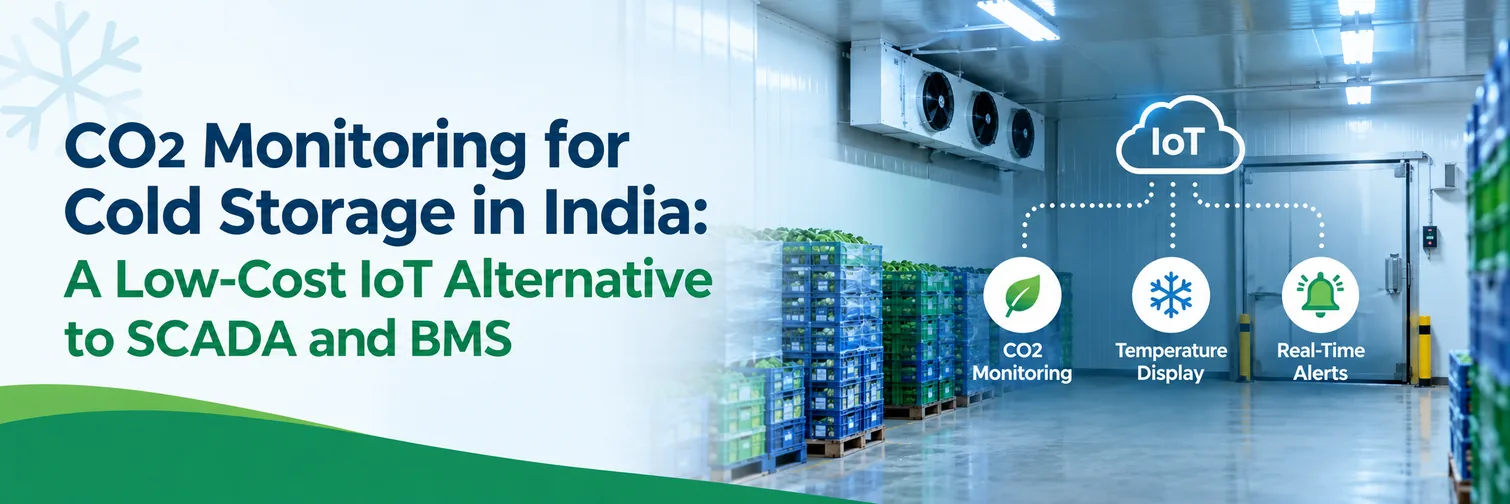
A cold storage owner came to us last week with a very practical problem. His newly built cold storage needed a government NOC, and to get it he had to show that CO2 levels were being monitored at several points inside the facility, with the readings displayed somewhere an inspector could see them. He had already priced a wired SCADA / BMS system: roughly ₹4–5 lakh, and the cabling alone would cost more than a full set of wireless CO2 monitors.
He bought seven VentPlus CO2 monitor and controller units instead and uses their remote-monitoring website as the display. This guide explains why CO2 monitoring matters in a cold storage, what the options cost, and how an IoT CO2 monitor can meet the same need for a fraction of the price.
Why CO2 Builds Up Inside a Cold Storage
Stored produce is alive. Potatoes, onions, fruits and vegetables keep respiring in storage: they take in oxygen and give off carbon dioxide, water vapour and heat. A cold storage chamber is built to be airtight and insulated so the cooling is not wasted, which means that CO2 has nowhere to go. In a loaded chamber, levels climb steadily day after day unless fresh air is let in.
That matters for two reasons:
- Produce quality: high CO2 around stored potatoes is linked to quality defects, such as dark spots when they are later fried for chips, and to poor sprouting in seed potatoes. Fruits and vegetables can develop off-flavours and internal damage.
- Worker safety: people load and unload chambers, grade produce and work in ante-rooms. CO2 is colourless and odourless, and very high levels cause headaches, drowsiness and breathlessness long before anyone notices.
The technical standards for cold storages published by the National Horticulture Board (NHB) address this directly: chambers are ventilated so that CO2 stays below the desired level, generally taken as about 4,000 ppm, which typically works out to 2 to 6 fresh-air changes per day. But you cannot tell whether that ventilation is working without measuring.
Why Cold Storage Owners Need to Show CO2 Data
Fitting an exhaust fan is not the same as proving the air is safe. Depending on your state, the authority and the type of facility, an inspector, licensing officer, insurer or large buyer may ask for evidence that ventilation and CO2 are being controlled. In our customer’s case, the NOC for a new facility required monitoring at multiple locations and a display of the readings that could be shown during inspection.
Even where it is not asked for, a continuous record protects you: if a lot of produce is rejected, you can show what the storage conditions actually were.
Requirements differ between states and departments, so always confirm with the authority issuing your NOC or licence exactly what they need to see.
Your Options: Manual Checks vs SCADA / BMS vs IoT Monitors
| Option | How it works | Typical cost & effort | Good for |
|---|---|---|---|
| Handheld CO2 meter | Staff walk around and write readings in a register | Low equipment cost, but depends on someone doing it every day; no continuous record | Occasional spot checks |
| Wired SCADA / BMS | Sensors cabled back to a PLC and a control-room PC | High: around ₹4–5 lakh in the quote our customer received, plus cabling, panel work and a programmer | Large plants that already run a SCADA or BMS |
| IoT Wi-Fi CO2 monitors | Each unit measures locally and uploads to a website over Wi-Fi | Low: no signal cabling, just a mains socket per unit and Wi-Fi coverage. Seven VentPlus units cost well under ₹1 lakh. | New and existing cold storages, warehouses, ripening chambers |
The biggest hidden cost in a wired system is the cabling and installation: long runs through insulated panels, conduits, junction boxes and labour. A wireless IoT system removes almost all of it, which is why IoT has become the standard low-cost alternative to wired industrial monitoring.
How VentPlus Works as a Cold Storage CO2 Monitor
VentPlus is a CO2 monitor and controller designed and made by Systellar Innovations in Meerut. Each Main Unit is a complete monitoring point:
- Industrial NDIR CO2 sensor measuring 400 to 5,000 ppm, which covers the ~4,000 ppm level cold storages are ventilated to stay below. It also measures temperature and humidity (up to 95% RH).
- Large backlit display on the unit itself, so staff and inspectors can read the level on the spot.
- Remote-monitoring website: every unit uploads live CO2, temperature and humidity over Wi-Fi. You see all your locations from any phone or laptop browser, with no app to install.
- Trend graphs and Excel download: CO2 over time plus fan ON/OFF history, and the last 30 days of data are stored in the records and can be exported as an Excel file for your records or for the inspector.
- Adjustable alarm and automatic ventilation: set your own CO2 levels for the beeper alert and for switching a fresh-air fan on and off, so the chamber is ventilated when CO2 rises instead of on a guess.
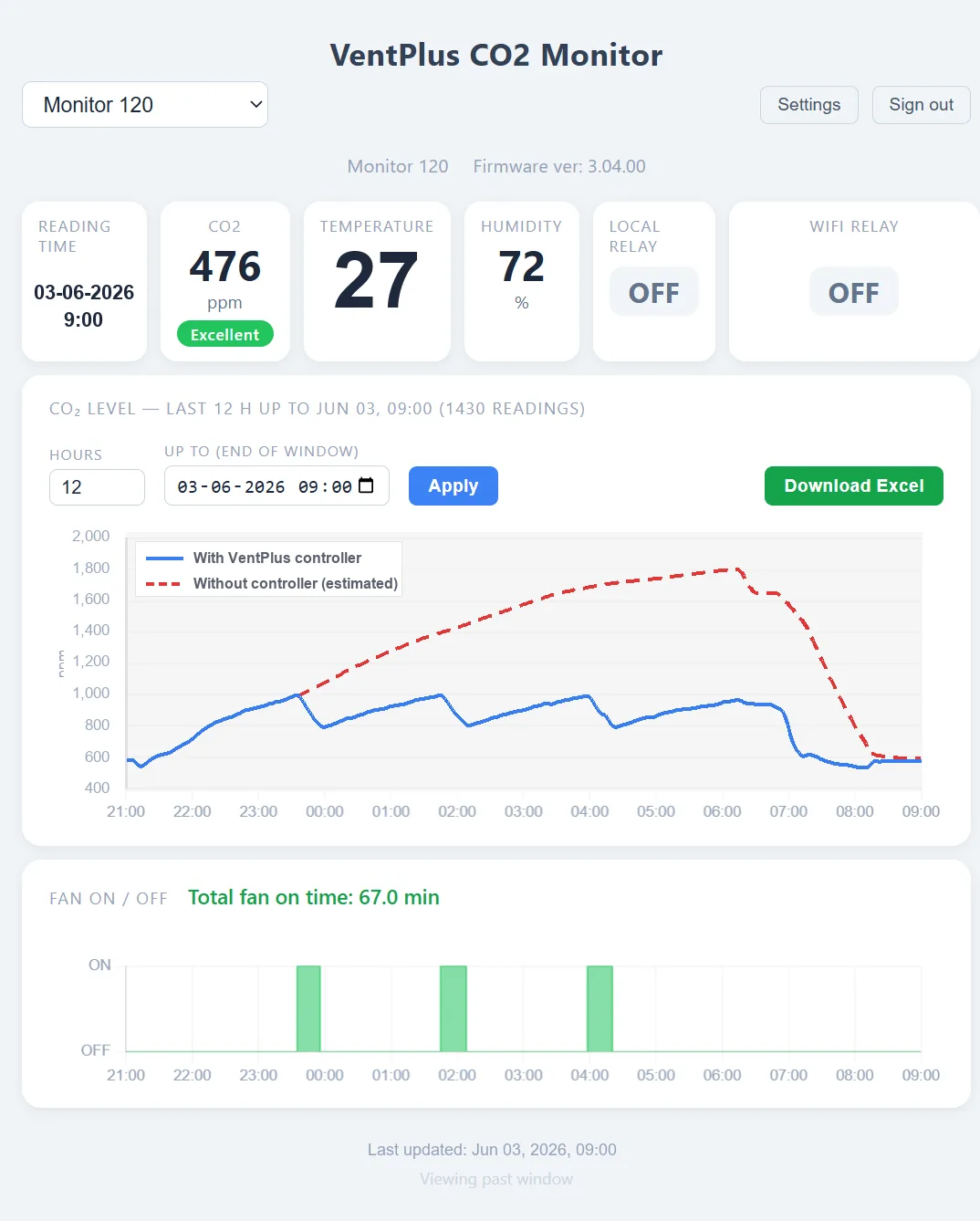
Want to try it yourself? Open a live VentPlus dashboard right now — no login, no signup, straight into a real device’s data.
Tap Open a Live Monitoring Dashboard and give it about 2 seconds to log in and load the live demo.
How to Show the Data to an Inspector
- Open the VentPlus remote-monitoring website on a phone, tablet or office computer. It shows the live reading of every unit in one place.
- Open the CO2 graph for any chamber to show how levels have behaved over the past days, and when the ventilation fan ran.
- Download the historic data as Excel and keep a printed or emailed copy with your compliance records. The website stores the last 30 days of records, so download the file at least once a month if you need a longer history.
Because each unit also has its own display, the inspector can walk to any chamber and compare the unit’s reading with what the website shows.
Planning a VentPlus Installation in a Cold Storage
- How many units: one unit is rated for roughly 100 sq m with moderate air circulation. Plan at least one per chamber, plus one each for ante-rooms, grading halls or any area where workers spend time. Our customer used seven.
- Where to mount: on a wall or pillar at mid-stack height, away from the door and out of the direct blast of the evaporator (cooler) fans, so the reading represents the chamber air rather than a draught.
- Wi-Fi coverage: insulated cold-room panels with metal skins block Wi-Fi strongly. Check signal strength inside each chamber before mounting, and add a Wi-Fi access point or repeater near the chambers if needed. This is the most common installation issue.
- Power: each unit needs a 230V AC socket.
- Ventilation: a small fresh-air fan can be switched from the unit directly. For larger ventilation systems, talk to our team about the right way to connect it.
Where VentPlus Fits, and Where It Does Not
To be clear about the limits:
- Suitable: cold storages running at 0°C and above, such as potato, onion, fruit and vegetable stores (typically 2–10°C), ripening chambers, pack houses and warehouses. The temperature sensor is rated 0–50°C.
- Not suitable: frozen stores below 0°C, which are outside the rated temperature range, and controlled-atmosphere (CA) stores that deliberately hold CO2 above 5,000 ppm.
- VentPlus is a CO2, temperature and humidity monitor. It does not detect ammonia refrigerant leaks; plant rooms using ammonia need a dedicated ammonia gas detector.
Frequently Asked Questions
What CO2 level should be maintained in a cold storage?
NHB technical standards for cold storages call for ventilation that keeps CO2 below the desired level, generally about 4,000 ppm, which usually means 2 to 6 air changes a day. The right figure also depends on the produce, so follow your storage consultant’s guidance for your crop.
Is CO2 monitoring mandatory for a cold storage NOC?
It depends on the state and the issuing authority. Some ask for evidence of CO2 monitoring and ventilation, as our customer’s NOC did. Confirm the exact requirement with the authority issuing your NOC or licence.
Can I see CO2 levels of all chambers in one place?
Yes. Every VentPlus unit uploads to the same remote-monitoring website, which shows all units together along with graphs and downloadable Excel data for the last 30 days.
Why is an IoT CO2 monitor cheaper than SCADA or BMS?
Most of the cost of a wired system is cabling, panels, programming and installation labour. Wi-Fi monitors need only a power socket and network coverage, so the total cost is a small fraction of a wired system.
Will VentPlus work in a sub-zero frozen store?
No. VentPlus is rated for 0–50°C, so it suits chilled stores such as potato and fruit cold storages, not frozen chambers.
Get CO2 Monitoring for Your Cold Storage
If you are building a new cold storage or need to show CO2 monitoring for an NOC or inspection, VentPlus gives you continuous CO2, temperature and humidity monitoring with inspector-ready records, without the cost and cabling of SCADA.
→ View VentPlus specifications and buy online
For multi-unit projects, call +91 95680 04455 or message us on WhatsApp with your number of chambers and their sizes, and we will suggest how many units you need.
Also read: safe CO2 levels and the ppm chart.