
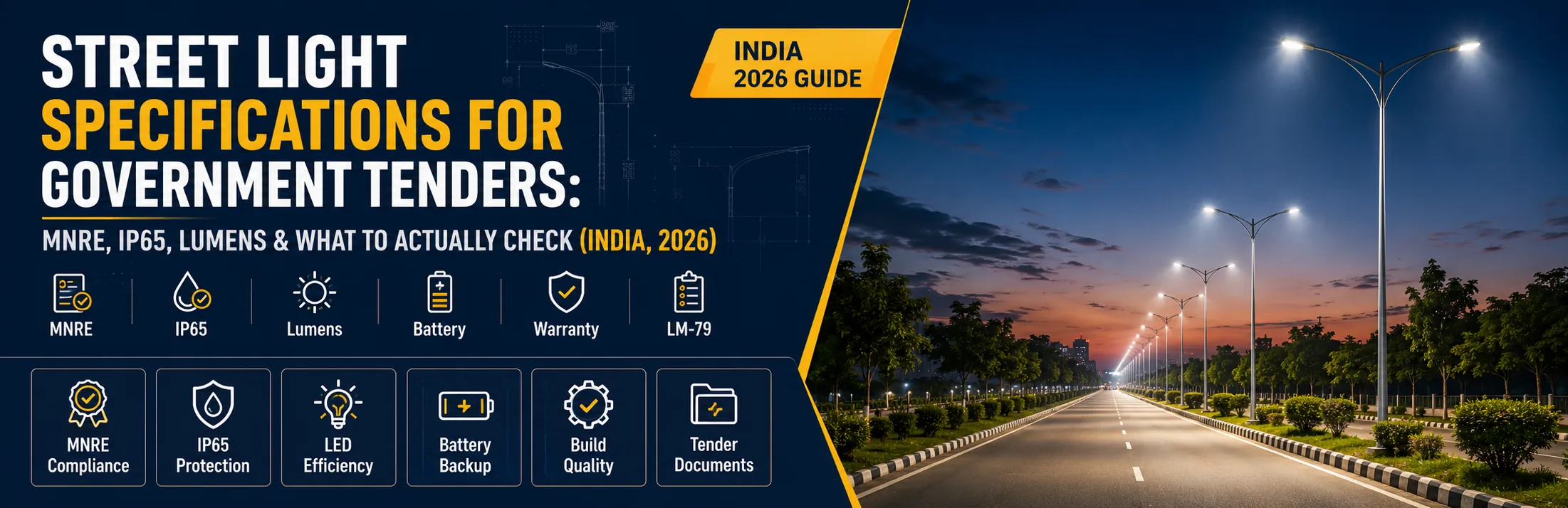
Street Light Specifications for Government Tenders: MNRE, IP65, Lumens & What to Actually Check (India, 2026)
1. The core spec parameters every street light tender tests
| Parameter | Typical tender requirement (2026) | Why it matters |
|---|---|---|
| Lumen efficacy | ≥110–130 lm/W (luminaire level) | Directly sets the energy bill for the light's whole life |
| Ingress protection | IP65 minimum (IP66 for coastal/harsh sites) | Dust-tight, water-jet proof — survives monsoon and dust storms |
| Surge protection | 4KV standard; 10KV for exposed/rural feeders | Grid transients and lightning are the #1 killer of LED drivers in India |
| Power factor | ≥0.90–0.95 | Utilities penalise poor PF; drivers need active PFC |
| Input voltage range | Wide range, e.g. 110–300V AC | Indian grid voltage swings widely — narrow-range fixtures fail early |
| CRI (colour rendering) | ≥70 | Faces and number plates must be recognisable on CCTV |
| LED life / lumen maintenance | 50,000 hrs to L70 | Roughly 11+ years at 12 hrs/night before output drops to 70% |
| Operating temperature | Typically −10°C to +50°C or wider | Luminaire must survive a Rajasthan summer, not a lab |
| Warranty | 3–5 years comprehensive | Filters out rebranded imports with no service network |
Two traps to avoid when drafting: specify efficacy at luminaire level (LED-chip efficacy numbers are inflated by 15–20%), and specify surge protection tested, not just claimed — ask for the test report.
2. Certifications: MNRE, NISE, NABL, BIS, ISO — who certifies what
- MNRE — issues specifications and guidelines for solar street lights; government solar tenders require MNRE-compliant systems.
- NISE — the government test lab whose reports demonstrate MNRE compliance for solar components.
- NABL — accredits the private labs whose photometric, IP and surge test reports tenders accept.
- BIS — Indian standards for luminaires and LED drivers (the IS 10322 family for luminaires, IS 15885 for control gear); many tenders cite these clauses directly.
- ISO 9001:2015 — manufacturer-level quality certification; commonly a minimum eligibility condition for bidders.
Systellar Innovations is an ISO 9001:2015 certified manufacturer (Meerut, founded 2012 by IIT alumni); the solar panels used in our solar street light products carry MNRE/NISE/NABL government-lab certification, and we supply against government and institutional orders including Indian Railways (RDSO specifications), ONGC and IIT Bombay.
3. Extra specifications for solar street light tenders
Solar tenders add a second layer of specs beyond the luminaire itself:
| Component | What tenders typically specify |
|---|---|
| Solar panel | Rated Wp with tolerance, MNRE/NISE-certified, 25-yr performance warranty |
| Battery | Chemistry (LiFePO4 now standard), Ah capacity, cycle life (≥2,000), replaceability |
| Autonomy | 2–3 cloudy days of operation without sun |
| Charge controller | MPPT preferred, with deep-discharge and overcharge protection |
| Dusk-to-dawn + dimming profile | Automatic operation; timed dimming (e.g. 100% till midnight, then reduced) to guarantee autonomy |
| Structure | Pole height, wind-speed rating, corrosion protection (hot-dip galvanised) |
See Systellar's tender-ready solar models: All-in-One solar street light and Integrated solar street light with LiFePO4 battery — both with motion-sensor dimming profiles that stretch autonomy.
4. Spec clauses for smart AC street lights (motion sensor, dimming, backup)
Smart-lighting tenders and institutional purchase specs increasingly add clauses that most catalogue fixtures cannot meet. If you are drafting, these are the clauses that separate genuine smart lights from rebadged fixtures:
- Motion-sensor dimming: "Luminaire shall operate at 100% output on detection of movement and automatically dim to 50% after a no-motion interval of approximately 30 seconds; the luminaire shall not switch fully OFF." — as implemented with a Panasonic PIR sensor in the Systellar ACLD (15W–50W, 220V AC).
- Dusk-to-dawn: "Automatic ON at dusk and OFF at dawn via integral light sensor; no external timer."
- Emergency backup: "On mains failure, luminaire shall continue operation from an integral battery for a minimum of 3 hours at full brightness, followed by progressive dimming" — the Systellar BBCL clause, with 110–300V AC input tolerance.
- Independence: each pole self-contained — no central inverter or control cabling required.
5. How to evaluate vendor compliance (a 5-point checklist)
- Test reports, not brochures — photometric report (lumen output and efficacy at luminaire level), IP-rating test, surge test, from NABL-accredited or government labs. Check the report is for the exact model offered.
- Manufacturer vs trader — ask where the product is manufactured and whether the bidder owns the design. Factory-direct manufacturers can honour 5-year warranties; importers often cannot.
- Reference orders — purchase orders from comparable government/institutional buyers, with contactable references.
- Warranty terms in writing — what is covered (driver? battery? sensor?), turnaround time, and who performs on-site service.
- Sample testing — for large tenders, test a sealed sample: measure actual wattage, check dimming behaviour at night, and run a backup-time test with the mains off.
6. Model specification clause — a copy-paste starting point
For purchase committees and RWAs drafting a spec for a 25W smart AC street light, the following clause set covers the parameters from this guide. Adjust wattage, quantities and warranty to your requirement:
"The luminaire shall be an LED street light of 25W (±5%) rated power, delivering a minimum luminaire-level efficacy of 110 lm/W, CRI ≥ 70, with lumen maintenance of L70 at 50,000 burning hours. Ingress protection shall be IP65 minimum, with pressure die-cast aluminium housing. The driver shall have power factor ≥ 0.95, surge protection of 4KV minimum, and shall operate over an input voltage range of 110–300V AC without damage or flicker. The luminaire shall switch ON/OFF automatically dusk-to-dawn via an integral light sensor, and shall incorporate a PIR motion sensor providing 100% output on detection of movement, dimming automatically to 50% output after approximately 30 seconds of no motion; the luminaire shall not switch fully OFF during night hours. The manufacturer shall be ISO 9001:2015 certified, shall submit photometric and surge test reports from NABL-accredited or government-recognised laboratories for the offered model, and shall provide a comprehensive on-site warranty of 3 years minimum. Products shall be manufactured in India."
For a backup variant, add: "On mains failure the luminaire shall continue operation from an integral battery for a minimum of 3 hours at full brightness, followed by progressive dimming." For solar tenders, add the panel/battery/autonomy clauses from the solar table above. Systellar can supply compliant datasheets, test reports and sample units against this clause set for the ACLD and BBCL.