
Smart Street Lighting Guide: Motion Sensors, Dusk-to-Dawn Control & Power-Cut Backup (India, 2026)
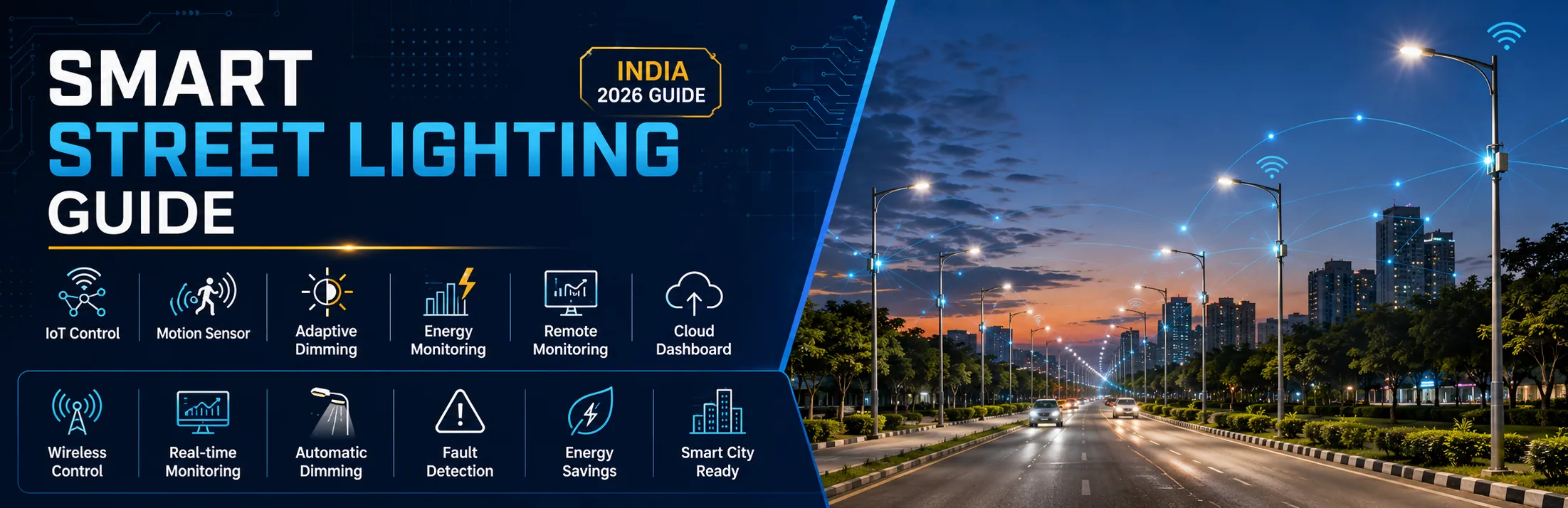
- What makes a street light "smart"?
- Running-cost calculator: smart vs plain LED vs conventional
- How PIR motion sensors & auto-dimming work
- Street lighting through power cuts (battery backup)
- Solar vs AC street lights: which to choose
- What wattage for what pole height?
- LED street light price in India (2026)
- FAQs
1. What makes a street light "smart"?
Three layers of intelligence, in increasing order of savings:
- Dusk-to-dawn control — a light sensor switches the lamp ON at nightfall and OFF at sunrise. No timer to set, no operator to forget. This alone ends the two classic wastes: lights burning at noon, and streets dark because someone didn't flip a switch.
- Motion-sensor auto-dimming — a PIR sensor keeps the light at 100% only while people or vehicles are present, dimming to 50% when the street is empty. This is where the big savings live — up to 60%.
- Power-cut backup — an internal battery keeps the light running when the grid fails, so security is never off duty.
Systellar builds all three into mains-powered AC street lights — see the AC street light range — as well as into solar street lights for off-grid sites.
2. Running-cost calculator: what a smart street light actually saves
Assumptions: 12 hours/night operation, 365 nights, commercial tariff ₹8 per unit. Comparing a 15W smart auto-dimming LED (Systellar ACLD), a plain 15W dusk-to-dawn LED, and an old 40W conventional fixture of similar light output:
| Per light, per year | 15W ACLD (motion + dimming) | 15W plain LED (dusk-to-dawn) | 40W conventional fixture |
|---|---|---|---|
| Energy consumed | ~43 units | ~66 units | ~175 units |
| Cost @ ₹8/unit | ~₹344 | ~₹526 | ~₹1,400 |
| Saving vs conventional | ~₹1,056/yr | ~₹874/yr | — |
Multiply by a gated society's 40 poles and the motion-sensor premium pays for itself quickly: roughly ₹42,000 saved every year vs conventional fixtures, and about ₹7,300/year vs plain LEDs — before counting reduced maintenance. (The exact dimming saving depends on how busy the street is at night; up to 60% vs always-on is typical of low-traffic internal roads.)
3. How PIR motion sensors and auto-dimming actually work
A PIR (Passive Infrared) sensor detects the moving body heat of a person or vehicle — it emits nothing, consumes almost nothing, and works in complete darkness. In the Systellar ACLD, a Panasonic PIR sensor drives this cycle:
- Street empty → light holds at 50% brightness (not off — the street stays visibly lit and camera-friendly).
- Person or vehicle enters the detection zone → light rises instantly to 100%.
- ~30 seconds after the last movement → light dims smoothly back to 50%.
The dim-not-off design matters. Lights that switch fully off create dark, unsafe gaps and confuse CCTV exposure; 50% dimming preserves safety while capturing most of the energy saving, since low-traffic streets spend the large majority of night hours with nobody on them.
4. Street lighting through power cuts: battery backup built into the pole
In much of India the grid still fails for minutes to hours at a time — and an unlit street at 9 PM is a security problem, not just an inconvenience. The conventional fix (a central inverter feeding the lighting circuit) is expensive and a single point of failure.
The smarter fix puts the battery inside each light. The Systellar BBCL (AC street light with emergency backup) charges its internal battery from the mains and switches over instantly when power fails: 3 hours at full brightness, then progressive dimming to stretch the remaining charge. It tolerates 110–300V AC input — so it also rides through the voltage sags that kill ordinary fixtures — and each pole is independent: one fault never darkens the whole street.
5. Solar vs AC street lights: which should you choose?
| Factor | Solar street light | Smart AC street light |
|---|---|---|
| Grid needed | No — fully independent | Yes — reliable mains supply |
| Running cost | Zero energy cost | Low (motion dimming cuts up to 60%) |
| Upfront cost | Higher (panel + battery) | Lower |
| Cabling | None — big saving on long stretches | Uses existing lighting circuit |
| Maintenance | Panel cleaning, battery after 5–8 yrs (LiFePO4) | Minimal |
| Best for | Villages, highways, parks, off-grid sites | Gated societies, campuses, factories, internal roads |
Rule of thumb: no reliable grid (or long cabling runs) → solar street light. Reliable grid already at the pole → smart AC light, with the ACLD for energy saving and the BBCL wherever lighting must survive power cuts. Many campuses mix both: solar on the periphery, smart AC on the internal roads.
6. What wattage street light for what pole height?
Wattage should follow pole height and road width — over-lamping wastes energy, under-lamping leaves dark patches between poles. Working guide at ~110 lm/W LED efficacy:
| Pole height | LED wattage | Approx. lumens | Typical location |
|---|---|---|---|
| 3–4 m | 15W | ~1,600 lm | Residential lanes, parks, pathways |
| 5–6 m | 25W | ~2,700 lm | Society internal roads, campus roads, parking |
| 7–9 m | 50W | ~5,500 lm | Main roads, factory perimeters, wide junctions |
Rule of thumb for spacing: poles every 2.5–3× the mounting height (a 6m pole → 15–18m spacing) keeps illumination even. The Systellar ACLD is available in 15W, 25W and 50W to cover all three tiers.
7. LED street light price in India (2026): honest ranges
Market-level ranges — actual pricing depends on wattage, build quality and features, which is why serious buyers quote per specification rather than per catalogue:
- Basic dusk-to-dawn LED street lights (15W–50W): roughly ₹1,200–4,000 in the open market. Watch for the corners cut at the bottom of the range: no surge protection, narrow voltage tolerance, optimistic wattage labels.
- Smart motion-sensor auto-dimming lights (like the ACLD): a modest premium over basic LED — typically recovered in the first 1–2 years through the up-to-60% energy saving (see the cost table above).
- Battery-backup models (like the BBCL): priced higher because each unit carries its own battery and charging electronics — compare against the real alternative, which is an inverter + cabling for the whole circuit, not against a plain fixture.
Systellar sells factory-direct from Meerut, so there is no distributor margin in the quote. For exact pricing on your wattage mix and quantities, send an enquiry or WhatsApp +91 95680 04455 — quotes go out within 24 hours.