
How the VentPlus CO2 Monitor & Controller Helps Mushroom Farms Get Better Yields
Button mushroom farming in India is moving indoors. Seasonal farms that grow only in the cool months of Himachal, Punjab or Haryana are being joined by AC-controlled farms that crop all year in Bihar, Odisha, Uttar Pradesh, Gujarat and the South. What separates a farm that produces steady flushes from one that struggles is rarely the compost recipe alone — it is whether the growing room can hold the right temperature, humidity and CO2 at each stage.
This guide explains how CO2 shapes a button mushroom (Agaricus bisporus) crop, the CO2, temperature and humidity each growth stage needs, and how the VentPlus CO2 monitor and controller holds the right level automatically. It ends with a farm setup checklist showing where VentPlus fits. It is written for growers planning a new farm, converting a seasonal farm to AC rooms, or trying to find out why yields are uneven.
Why CO2 Decides the Quality of Your Mushroom Crop
Unlike green plants, mushrooms give off CO2 as they grow. In a sealed AC room the level climbs quickly. When CO2 stays too high during cropping, the signs show up in your harvest:
- Long, thin stems and small caps (mushrooms “reaching” for air)
- Delayed or aborted pinning
- Uneven flushes and lower marketable weight
Most farms manage fresh air by timer or by feel — so many minutes of fan every hour, adjusted by the supervisor. But the right amount of fresh air changes with the stage, the load in the room, the outside temperature and the time of day. Too little air gives poor mushrooms; too much fresh air wastes cooling energy and dries the casing. A CO2 controller replaces the guess with a number.
The same logic works in reverse during spawn run and case run, when you want CO2 to stay high: a reading tells you whether the room is holding its CO2-rich atmosphere or losing it through leaky doors.
The Right CO2, Temperature and Humidity at Each Growth Stage
Every piece of equipment on the list exists to deliver one of these stages. Figures below are typical published values; exact numbers depend on the strain, so always follow your spawn supplier’s guidance.
| Stage | Duration (typical) | Temperature | Humidity | CO2 |
|---|---|---|---|---|
| Phase I composting (yard or bunker) | ~2 weeks | Compost self-heats | Kept moist | — |
| Phase II pasteurisation & conditioning (tunnel) | ~6–7 days | ~57–60°C to pasteurise, then ~45–50°C until ammonia is gone | — | Fresh air to clear ammonia |
| Spawn run | ~12–15 days | ~24–25°C in compost | 85–95% | High is fine — often above 5,000 ppm |
| Case run | ~7 days | ~24°C | ~95% | High, above ~7,500 ppm |
| Pinning & cropping | ~4–6 weeks, several flushes | Air lowered to ~15–18°C | ~85–90% | Low: ~800–1,000 ppm |
Notice the pattern: the mycelium likes a CO2-rich room while it grows, and then needs a sharp drop in temperature and CO2 to switch from growing mycelium to forming mushrooms. That switch, called “flushing” the room with fresh air, is where many farms lose yield — and it is invisible without a CO2 reading.
How VentPlus Controls CO2 in a Mushroom Growing Room
VentPlus is a CO2 monitor and controller designed and made in Meerut by Systellar Innovations. In a crop room it works as a simple, plug-and-play ventilation controller:
- Measures CO2 with an industrial NDIR sensor (400–5,000 ppm, ±(50 ppm + 5% of reading)), plus temperature and humidity. It is rated for up to 95% RH.
- Switches your fresh-air or exhaust fan ON when CO2 rises above your set limit — for example 1,000 ppm during cropping.
- Switches the fan OFF when fresh air brings CO2 back down to your lower limit — for example 800 ppm — so the room is not over-ventilated.
- Uploads the data over Wi-Fi to the VentPlus remote-monitoring website, where you can watch every room from your phone and download the last 30 days of CO2, temperature, humidity and fan ON/OFF records as Excel.
During spawn run and case run, when CO2 is meant to be above 5,000 ppm, the display shows 5,000+ — confirming the room is in its high band. The precise control work happens in the pinning and cropping range, which sits well inside the sensor’s range. All thresholds are set from the front panel, so you can adjust them per strain and per stage.
Planning tips: use one VentPlus per growing room; mount it at canopy level on a wall or pillar, away from the direct air outlet of the AC or AHU; and check Wi-Fi signal inside insulated rooms, as PUF panels block Wi-Fi strongly. A small fresh-air fan plugs directly into the unit’s socket (3A / 700W); for larger fans a special build with a relay output that switches on the fan contactor is available on request — call us before ordering.
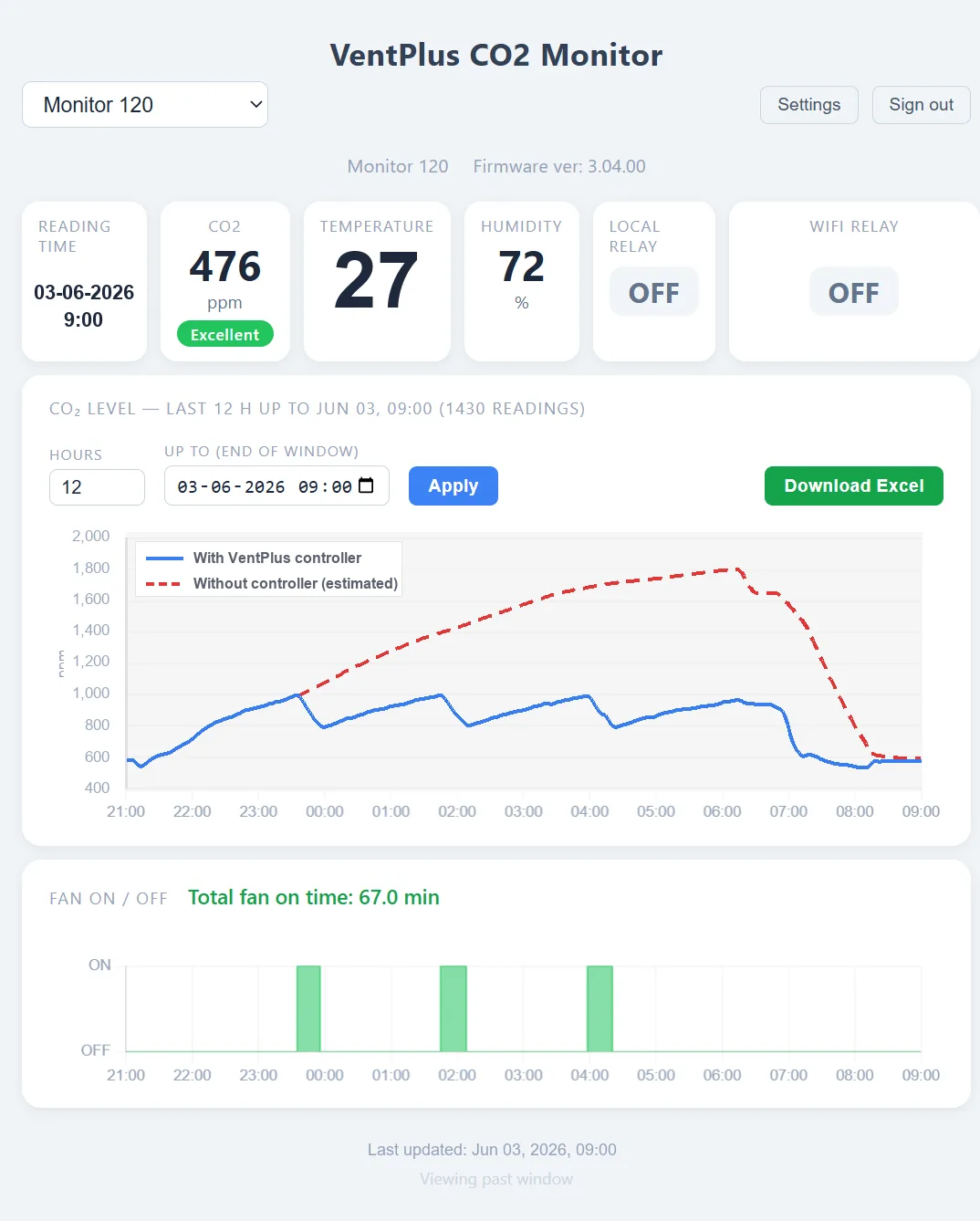
Want to try it yourself? Open a live VentPlus dashboard right now — no login, no signup, straight into a real device’s data.
Tap Open a Live Monitoring Dashboard and give it about 2 seconds to log in and load the live demo.
For species-wise CO2 bands (oyster, milky, shiitake) and more detail, see the VentPlus mushroom farm CO2 controller guide on ventplus.in.
Buy VentPlus online
VentPlus CO2 Monitor & Controller — Main Unit: ₹8,499 (incl. GST). NDIR CO2 sensor, temperature and humidity, built-in fan socket, Wi-Fi remote monitoring with the last 30 days of records and Excel download.
Wi-Fi Relay Unit (optional): ₹2,499 (incl. GST) — switches a second fan elsewhere in the building over Wi-Fi, no cable run needed.
🚚 Free shipping across India from our factory in Meerut. Buying for several rooms or sheds? Call +91 95680 04455 for multi-unit pricing.
Seasonal vs AC Mushroom Farms: Why Automatic CO2 Control Matters More Indoors
| Seasonal farm | AC-controlled farm | |
|---|---|---|
| Crops per year | 1–2, only in cool months | 4–6 or more, year-round |
| Growing room | Thatched or brick house, natural ventilation | Insulated (PUF panel) room with cooling, heating and fresh-air control |
| Compost | Often long-method outdoor compost | Short-method compost pasteurised in a Phase II tunnel |
| Climate control | Opening doors and windows by feel | Set-points for temperature, humidity and CO2 held automatically |
| Main risk | Weather decides the crop | Equipment failure or poor control goes unnoticed |
An AC farm costs more to build, but it turns mushroom growing from a season into a business with predictable output — provided the rooms are actually controlled.
Mushroom Farm Setup Checklist: Where VentPlus Fits
1. Composting equipment
- Concrete composting yard or aerated bunkers for Phase I, with a drainage pit (goody water tank) to recycle run-off.
- Front-end loader or tractor with turner for turning and mixing wheat straw, chicken manure, gypsum and other ingredients. Small farms turn by hand.
- Water pumps and sprinkler lines to wet the straw evenly.
- Compost thermometers / probes to track heating in the stack.
2. Phase II tunnel (pasteurisation)
- Insulated tunnel with a perforated (grated) floor so air can be blown up through the compost.
- High-pressure blower with a fresh-air/recirculation damper.
- Steam boiler or other heat source to reach pasteurisation temperature.
- Multiple temperature probes in the compost and in the air, ideally connected to a tunnel controller.
Farms that do not want to invest in composting can buy ready Phase II or Phase III (spawn-run) compost from a commercial compost unit and start directly with growing rooms.
3. Spawning and filling
- Quality spawn from a reliable lab. ICAR–Directorate of Mushroom Research, Solan publishes strains and runs training.
- Spawn mixer or clean mixing floor, weighing scale.
- Polythene bags or trays, or a filling line for shelf systems.
- Casing material (commonly a pasteurised mix of farmyard manure and spent compost, or peat where available) and a casing-soil sterilisation setup.
4. Growing (cropping) rooms
- Insulated PUF panel rooms with cold-room doors — insulation decides your cooling bill.
- Racks: GI or aluminium shelves (commonly 4–5 tiers) or bag racks, with walking space for picking.
- Cooling: an air handling unit (AHU) with chilled water, or split/package AC units sized for the summer peak.
- Heating for north-Indian winters, so the spawn and case run stay near 24–25°C.
- Humidifier or fogger and a water line for watering the casing.
- Fresh-air fan with filter and an exhaust fan — your only tools for lowering CO2.
- Air distribution: poly ducts or a ducted AHU so every rack gets even air.
- CO2 monitor & controller that switches the fresh-air or exhaust fan automatically (details below).
- Temperature and humidity monitoring for every room, ideally with remote alerts.
5. Harvest and post-harvest
- Picking knives, trays and trolleys.
- Pre-cooling / cold room at about 2–4°C to take field heat out quickly — button mushrooms lose shelf life fast at room temperature.
- Weighing and punnet packing with perforated film.
- Refrigerated transport for longer routes to mandis, hotels and supermarkets.
6. Hygiene and power
- Footbaths, sprayers and disinfectants to control green mould, flies and nematodes.
- Insect nets on air inlets and yellow sticky traps.
- Generator or inverter backup — a few hours without cooling or fresh air in summer can damage a flush.
Common Mistakes That Cost Mushroom Yield
- Undersized cooling. Cooling sized on a winter day fails in May and June, exactly when prices are best.
- No fresh-air control. Rooms built airtight for cooling, with no measured way to bring in fresh air.
- One thermometer for the whole farm. Each room is its own climate; monitor every room.
- Buying compost and spawn only on price. Poor compost cannot be rescued by good equipment.
- No power backup for fans and cooling.
- Skipping training. Attend a course at ICAR–DMR Solan, a Krishi Vigyan Kendra or a state horticulture department before investing.
Frequently Asked Questions
What is the ideal CO2 level for button mushrooms?
During spawn run and case run CO2 can be high (often above 5,000 ppm). For pinning and cropping it must be brought down to roughly 800–1,000 ppm with fresh air. Exact values depend on the strain.
What equipment is needed for button mushroom farming?
A commercial farm needs composting facilities (or a supply of ready compost), a Phase II pasteurisation tunnel, insulated growing rooms with racks, cooling and heating, humidifiers, fresh-air and exhaust fans, CO2 and temperature/humidity control, and a cold room for harvested mushrooms.
What temperature do button mushrooms need?
About 24–25°C during spawn run and case run, then air temperature is lowered to about 15–18°C to start pinning and cropping, with humidity around 85–90%.
Can I grow button mushrooms all year in India?
Yes, in insulated growing rooms with cooling, heating and fresh-air control. Without climate control, button mushrooms are limited to the cool season.
How many CO2 controllers does a mushroom farm need?
One per growing room, because each room is at its own stage and has its own CO2 level. VentPlus units on the same Wi-Fi all show on one remote-monitoring website.
Is there a subsidy for mushroom farming?
Mushroom production units have been supported under central and state horticulture schemes. Check the current terms with your state horticulture department or the National Horticulture Board before you build.
Get Your Growing Rooms Under Control
Better pins, fuller caps and even flushes start with knowing the air in each room. Tell us your number of growing rooms, their size and your existing ventilation, and we will recommend a VentPlus setup. Call +91 95680 04455 or message us on WhatsApp.
Also read: CO2 monitoring for cold storage · safe CO2 levels and the ppm chart · CO2 for greenhouses on ventplus.in