
How to Convert a Normal Inverter to a Solar Inverter Without Replacing It
You already own a home inverter and batteries. You do not need to throw them away to start using solar power. Add solar panels and the right solar charge controller with a Solar Management Unit (SMU), and your normal inverter runs on solar during the day and goes back to the grid only when the battery needs it.
This guide explains how the conversion works, which controller fits your inverter’s battery voltage, how many panels you need, what it costs, and what it will not do, so you can decide before you buy.
यह गाइड हिंदी में पढ़ें: नॉर्मल इन्वर्टर को सोलर इन्वर्टर कैसे बनाएं
How a Normal Inverter Becomes a Solar Inverter
A normal (non-solar) home inverter charges its battery only from the grid. Converting it needs two jobs done:
- Charge the battery from solar panels. A solar charge controller sits between the panels and the battery and charges the battery safely. Your inverter does not need to know the panels exist.
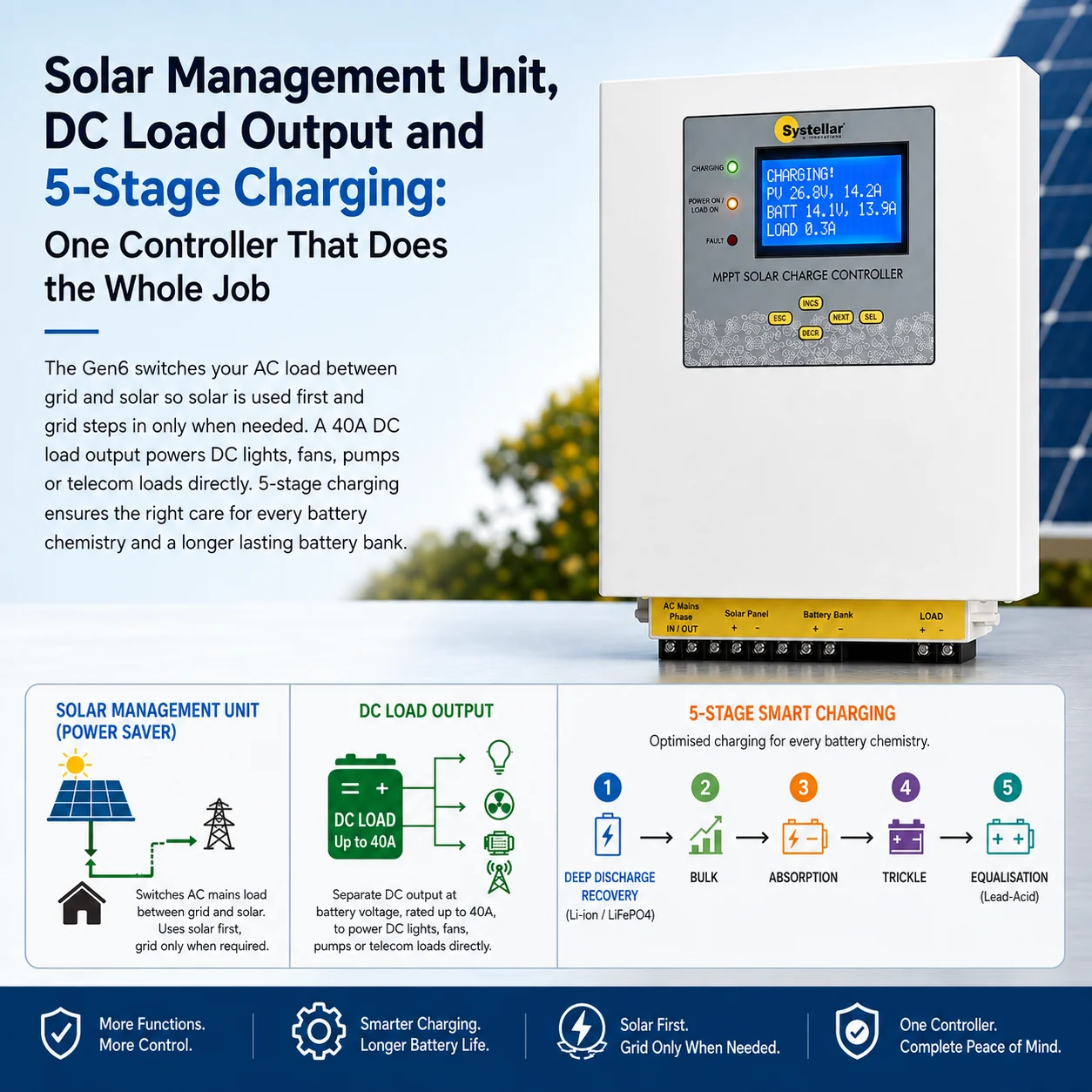
- Make the inverter use that solar energy first. Left alone, the inverter keeps running your home from the grid whenever the grid is on, and the solar energy sits unused in the battery. A Solar Management Unit (SMU), also called a power saver, fixes this.
The SMU’s relay is wired into your inverter’s mains (grid) AC input. When the battery is well charged by the solar panels, the relay cuts off grid power, so your inverter runs the house from solar-charged battery energy. When the battery voltage drops to the level you set, the grid reconnects automatically and the inverter carries on as before. No manual switching is needed.
What You Need
- Your existing inverter and battery (tubular, SMF or LiFePO4).
- Solar panels sized to your battery bank (see below).
- An MPPT solar charge controller matched to your battery voltage.
- An SMU (power saver). Built into the CC-MPPT-Gen6; an add-on for the CC-MPPT-Compact.
- A qualified electrician for the DC wiring and the connection at the inverter’s mains input.
Which Solar Charge Controller Fits Your Inverter?
Start with your inverter’s battery voltage. Most home inverters use one 12V battery or two in series (24V). Larger inverters use 36V or 48V banks, and inverters in petrol pumps, schools and offices often run on 96V–240V banks.
| Your battery bank | Controller | SMU | Price (incl. GST) |
|---|---|---|---|
| 12V or 24V | CC-MPPT-Compact-100, 25A or 50A | Add-on, ₹1,499 | from ₹5,999 |
| 12V, 24V, 36V or 48V | CC-MPPT-Compact-200, 25A or 50A | Add-on, ₹1,499 | from ₹6,599 |
| 12V, 24V, 36V or 48V, larger arrays | CC-MPPT-Gen6, 50A or 75A | Built in | ₹9,899 (50A) · ₹12,999 (75A) |
| 72V to 240V | CC-PWM-HV, 40A | Ask us | see product page → |
Check your battery type before you order. The CC-MPPT-Gen6 works with every battery type (tubular, SMF and LiFePO4); you select the type in its settings. The CC-MPPT-Compact is factory-set for one battery type, so choose the lead-acid or lithium version that matches your battery when you order. All models are made in India and carry a 2-year warranty. Not sure? Use the system sizing tool on our solar charge controllers page, or call us.
How Many Solar Panels Do You Need?
A quick rule: divide your total solar panel wattage by your battery voltage. The answer is roughly the charging current in amps, and your controller’s rating should be above it.
- Two 335W panels (670W) on a 24V battery: 670 ÷ 24 ≈ 28A, so choose a 50A controller.
- Four 335W panels (1,340W) on a 48V battery: 1,340 ÷ 48 ≈ 28A, so a 50A controller fits.
The panels’ open-circuit voltage (Voc) must also stay inside the controller’s limit (85V for Compact-100, 175V for Compact-200 and Gen6) on the coldest morning. Your installer checks this, or our sizing tool does it for you.
Buy a Solar Charge Controller for Your Inverter
CC-MPPT-Gen6 with built-in SMU: ₹9,899 (50A) · ₹12,999 (75A). 12V to 48V, 175V Voc, 2-year warranty.
CC-MPPT-Compact: from ₹5,999, factory-set for your battery type (choose the lead-acid or lithium version), plus the SMU Converter / Power Saver add-on at ₹1,499.
🚚 Free shipping across India from our factory in Meerut. Need help choosing? Call +91 95680 04455 or WhatsApp us.
What This Conversion Will Not Do
- No government subsidy. PM Surya Ghar subsidy is for grid-connected rooftop systems installed by a registered vendor. A battery-based conversion like this one does not qualify, and there is no net metering. Read about the UP solar panel subsidy if that is what you want.
- It does not make your inverter bigger. The inverter’s kVA rating still limits how much load you can run.
- Savings depend on your panels and your load. More panels and daytime use mean more grid units saved. A small array on a large load saves less.
Frequently Asked Questions
Can I convert my normal inverter to a solar inverter without replacing it?
Yes. Add solar panels, an MPPT solar charge controller matched to your battery voltage and a Solar Management Unit (SMU). The controller charges your existing battery from the panels and the SMU makes the inverter use that solar energy before the grid. Your inverter and battery stay as they are.
What is an SMU (Solar Management Unit)?
An SMU, also called a power saver, is a relay wired into your inverter’s mains AC input. When the battery is well charged by solar, it cuts off grid power so the inverter runs on battery energy. When the battery voltage drops to the level you set, the grid reconnects automatically. The CC-MPPT-Gen6 has it built in; for the CC-MPPT-Compact it is a ₹1,499 add-on.
Which solar charge controller should I buy for my home inverter?
Match the controller to your battery voltage. For a 12V or 24V home inverter, the CC-MPPT-Compact (from ₹5,999) with the SMU add-on suits most homes; order the version made for your battery type, because the Compact is factory-set. For 36V or 48V banks, larger panel arrays, or if you may change your battery type later, choose the CC-MPPT-Gen6 (₹9,899 for 50A), which works with all battery types and has the SMU built in.
How many solar panels do I need for my inverter battery?
Divide your total panel wattage by your battery voltage to get the approximate charging current, and choose a controller rated above it. For example, 670W of panels on a 24V battery gives about 28A, so a 50A controller fits. The panels’ Voc must also stay within the controller’s input limit.
Will my inverter run on solar at night?
It runs on the energy the solar panels stored in the battery during the day. When the battery voltage drops to the level you set, the SMU reconnects the grid automatically, so the house never goes dark and the battery is not over-discharged.
Do I get a government subsidy for converting my inverter to solar?
No. The PM Surya Ghar subsidy covers grid-connected rooftop solar systems installed through registered vendors. Converting an existing inverter with a charge controller and SMU is a battery-based setup and does not qualify.
Which batteries work with a converted inverter?
The usual Indian inverter batteries: tubular and SMF lead-acid, and LiFePO4 lithium. The CC-MPPT-Gen6 works with all of them; you select the battery type in its settings. The CC-MPPT-Compact is factory-set for one battery type, so order the lead-acid or lithium version that matches your battery.
Get Help Choosing
Tell us your inverter model, battery voltage and how many panels you plan to install, and we will recommend the right controller. Call +91 95680 04455, message us on WhatsApp or send an enquiry.
Also read: Solar charge controllers: compare models and prices · MPPT vs PWM solar charge controller · How to install an MPPT charge controller