
How the VentPlus CO2 Monitor & Controller Helps Poultry Farms Raise Healthier Broilers
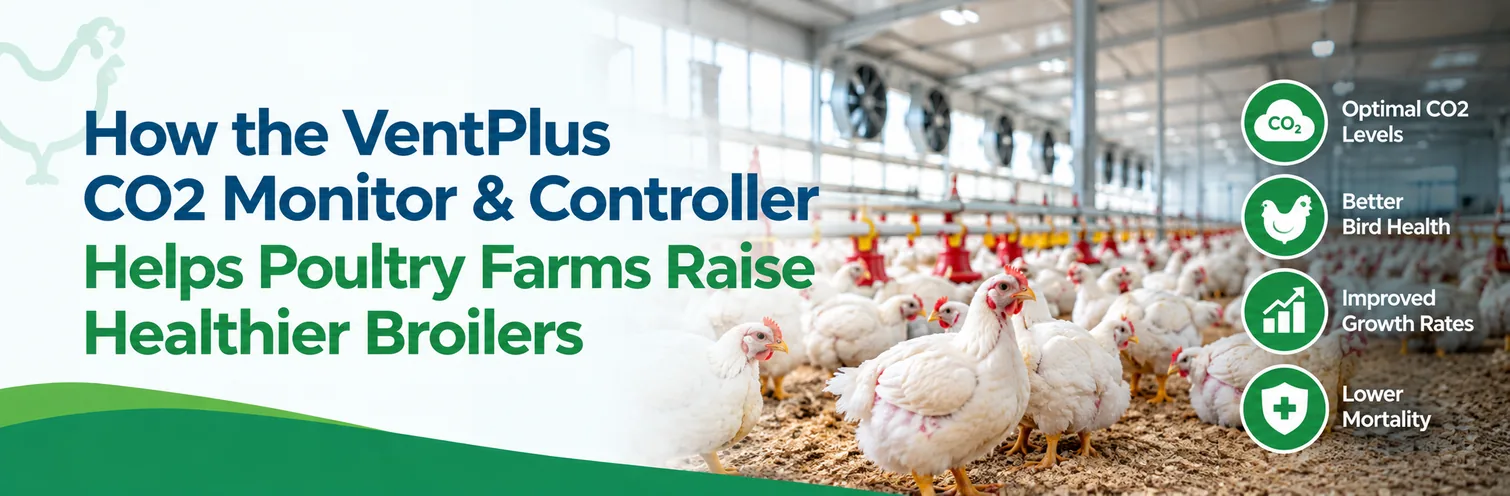
Indian broiler farming is changing fast. Integrators and progressive farmers are moving from traditional open-sided sheds with curtains to environmentally controlled (EC) sheds with tunnel fans, cooling pads and controllers. The reason is simple: a controlled shed keeps birds comfortable in 45°C summers and cold winter nights, which shows up directly in weight gain, feed conversion ratio (FCR) and mortality.
This guide explains why CO2 builds up in broiler sheds, the CO2, temperature and ammonia targets a shed must hold, and how the VentPlus CO2 monitor and controller runs your ventilation fans on a CO2 number instead of a timer. It ends with a shed equipment checklist showing where VentPlus fits.
Why CO2 Builds Up in Broiler Sheds During Brooding
For the first week the shed has to be warm, so fans are turned down, inlets are closed and gas brooders run. But gas brooders produce CO2 of their own, on top of the CO2 from the chicks and the litter. So CO2 rises at exactly the moment ventilation is at its lowest. Tight sheds on cold nights can pass the 3,000 ppm ceiling without anyone noticing — the shed feels warm, which is what the farmer is watching.
Most farms run minimum ventilation on a timer: so many seconds of fan in so many minutes, set at the start of the flock and adjusted by feel. A timer does not know that last night was colder, the litter is wetter or the brooders ran longer. CO2 reflects all three, because it is their combined result. Controlling the minimum-ventilation fan on CO2 gives the birds fresh air when they need it — and avoids over-ventilating and wasting brooding heat when they do not.
CO2, Temperature and Ammonia Targets for Broiler Sheds
| Parameter | Target | Why it matters |
|---|---|---|
| Brooding temperature | About 32–33°C at chick level at placement, reduced gradually as birds grow | Chicks cannot regulate body heat in the first days |
| CO2 | Below 3,000 ppm at bird level (below 2,500 ppm preferred) | High CO2 in brooding is linked to poorer early growth and ascites |
| Ammonia | Below 10 ppm | Damages the respiratory tract and eyes; raises disease risk |
| Relative humidity | Moderate; avoid wet litter | Wet litter drives ammonia and foot problems |
Figures follow published broiler management guides from the major breeding companies (for example the Cobb broiler management guide). Always follow the guide for your breed and your integrator’s instructions.
How the VentPlus CO2 Controller Works in a Poultry Shed
VentPlus, made in Meerut by Systellar Innovations, is a CO2 monitor and controller that switches your minimum-ventilation fan on a CO2 set-point:
- Mount it at chick level, protected from direct dust blast and water spray. The reading that matters during brooding is at the floor, not at the walkway.
- Set the thresholds, for example fan ON at 3,000 ppm and OFF at 1,600 ppm as a conservative brooding-week starting point. Adjust them from the front panel as birds grow.
- Connect the fan. Small minimum-ventilation fans plug straight into the unit’s socket (3A / 700W). Shed exhaust and tunnel fans are much larger, so for these we build VentPlus with a relay output that switches on your fan contactor (available on request as a special build) — the relay energises the contactor coil and the contactor runs the large fan. Your electrician wires the contactor in the fan panel as usual. The optional Wi-Fi Relay Unit lets the switched socket sit at the fan end of a long shed while the sensor stays at bird level.
- Watch it from home. Readings upload over Wi-Fi. On a cold night you can check the shed from your phone and see the whole night’s CO2 curve in the morning. The last 30 days of CO2, temperature, humidity and fan records are stored and download to Excel.
The NDIR sensor reads 400–5,000 ppm with ±(50 ppm + 5% of reading) accuracy, covering the whole range a shed operates in. The unit is rated for 0–50°C and up to 95% RH, and an Auto/Off/On switch lets the supervisor override it by hand.
Running large shed fans: most broiler sheds use big exhaust fans that cannot plug into a socket. VentPlus handles them with a relay output for your fan contactor, so one unit at chick level can control the minimum-ventilation fans of the whole shed. It is available on request as a special build — call +91 95680 04455 or WhatsApp us with your fan details before ordering, so we can supply the relay-output version.
What VentPlus does not do: it does not measure ammonia. In an under-ventilated shed CO2 and ammonia usually rise together, so better CO2-based ventilation usually helps ammonia too, but you still need an ammonia check. It also does not replace your main temperature controller for tunnel ventilation and cooling pads; it adds the air-quality measurement that controller is missing.
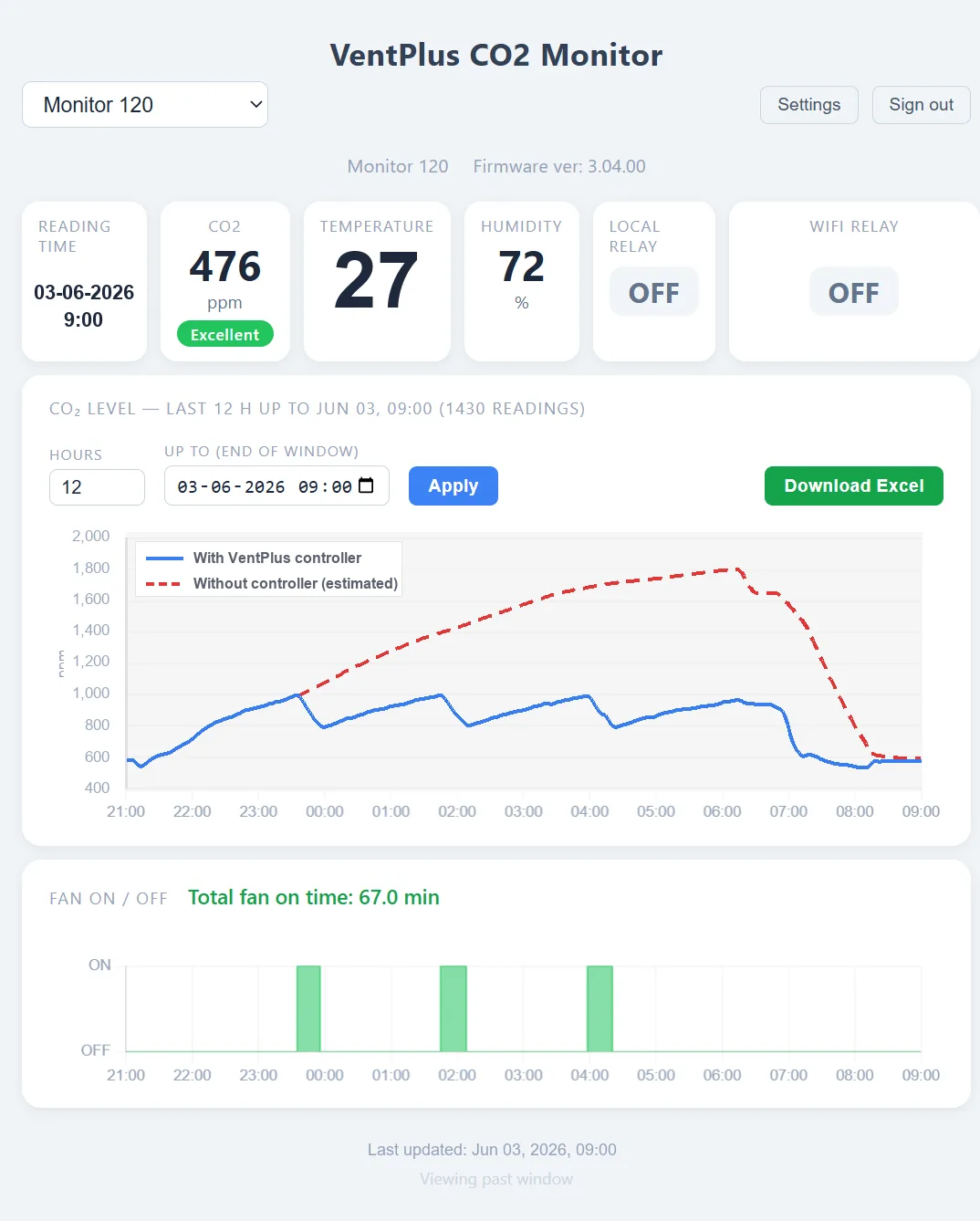
Want to try it yourself? Open a live VentPlus dashboard right now — no login, no signup, straight into a real device’s data.
Tap Open a Live Monitoring Dashboard and give it about 2 seconds to log in and load the live demo.
For recommended settings by bird age and more questions from farmers, see the VentPlus CO2 controller for poultry farms page, and size your minimum-ventilation fans with the free VentPlus tools.
Buy VentPlus online
VentPlus CO2 Monitor & Controller — Main Unit: ₹8,499 (incl. GST). NDIR CO2 sensor, temperature and humidity, built-in fan socket, Wi-Fi remote monitoring with the last 30 days of records and Excel download.
Wi-Fi Relay Unit (optional): ₹2,499 (incl. GST) — switches a second fan elsewhere in the building over Wi-Fi, no cable run needed.
🚚 Free shipping across India from our factory in Meerut. Need the relay-output version for large shed fans (special build, available on request), or buying for several sheds? Call +91 95680 04455 for multi-unit pricing.
Minimum, Transitional and Tunnel Ventilation: Where CO2 Control Helps
Buying fans is easy; running them correctly is where performance is won or lost. A well-run shed moves between three modes:
- Minimum ventilation — for brooding and cold weather. The goal is air quality, not cooling: just enough fresh air to remove CO2, moisture and ammonia without chilling the birds. Air comes in through inlets high on the walls or ceiling so it mixes with warm air before reaching the chicks.
- Transitional ventilation — as birds grow and weather warms, more fans run through the side inlets to remove heat without creating drafts.
- Tunnel ventilation — in hot weather, all tunnel fans pull air along the length of the shed through the cooling pads. The air speed over the birds creates a wind-chill effect that cools grown birds. Young birds are very sensitive to drafts: breeder guides warn that even about 0.5 m/s can chill day-old chicks.
Open-Sided Shed vs EC Shed
| Open-sided shed | EC (environment-controlled) shed | |
|---|---|---|
| Ventilation | Natural, curtains raised or lowered by hand | Fans, inlets and tunnel ventilation run by a controller |
| Summer cooling | Foggers and shade, limited | Cooling pads with tunnel airflow |
| Bird density | Lower | Higher, because climate is controlled |
| Performance | Varies with weather | More consistent weight, FCR and liveability |
| Cost | Low | Higher build and power cost; needs backup power |
Poultry Shed Equipment Checklist: Where VentPlus Fits
1. Shed structure
- Shed frame (steel or RCC), roof with insulation or false ceiling to cut heat load.
- Side curtains with winches for open sheds; sealed side walls for EC sheds.
- Air inlets (side-wall or ceiling) for minimum ventilation.
- Bird-proof netting and rodent-proofing.
2. Brooding equipment
- Brooders: gas brooders (common in commercial sheds), electric or charcoal/wood brooders on smaller farms.
- Chick guards to hold chicks near heat, feed and water in the first days.
- Paper, chick feeders and trays for day-old chicks.
- Thermometers at chick level — not at head height.
3. Feeding equipment
- Pan feeders (manual or automatic feed lines with hopper and motor).
- Feed silo or bins to keep feed dry and pest-free.
- Weighing scale for feed and weekly bird weights.
4. Drinking equipment
- Nipple drinker lines with drip cups — cleaner water and drier litter than open bell drinkers.
- Pressure regulators, water filter and header tank.
- Medicator / dosing pump for vaccines, vitamins and water sanitation.
5. Ventilation equipment
- Tunnel exhaust fans (large box or cone fans at one end of the shed) sized for the shed’s total air volume.
- Minimum-ventilation fans — smaller fans that run on a cycle in cold weather and during brooding.
- Circulation / stirring fans to even out temperature.
- Light traps on fans and inlets where lighting is controlled.
6. Cooling equipment
- Evaporative cooling pads (cellulose) at the inlet end, with pump, water tank and distribution pipe.
- Foggers / misters — used alone in open sheds or to support pads.
7. Control and monitoring
- Environment controller that runs fans, pads and heaters on temperature (and often humidity).
- CO2 monitor & controller for minimum ventilation during brooding and cold nights, with a relay output to switch large fans through a contactor (explained below).
- Ammonia meter or sensor to check litter conditions.
- Alarm system for power failure and high temperature.
8. Lighting, power and hygiene
- LED lighting with dimmer and timer for lighting programmes.
- Generator with auto changeover — in an EC shed, a power cut in summer can kill birds within minutes.
- Litter raking machine, footbaths, pressure washer and disinfection sprayer for biosecurity.
Ventilation Checklist Before You Buy
- Fan capacity matched to shed volume for your hottest month, not an average day.
- Cooling pad area matched to fan capacity — too little pad area starves the fans and raises power bills.
- Inlets for minimum ventilation, not just tunnel fans.
- Measurement at bird level: temperature, CO2 and ammonia.
- Backup power and alarms sized for all fans and pumps.
- After-sales service and spare parts availability near your farm.
Frequently Asked Questions
What is the maximum CO2 level in a broiler shed?
Published broiler management guides give about 3,000 ppm at chick level as the maximum, with 2,500 ppm preferred, especially during brooding.
What equipment is needed for a broiler poultry farm?
Brooders and chick guards, feeders and feed storage, nipple drinker lines with a medicator, exhaust and circulation fans, cooling pads or foggers, an environment controller, CO2 and ammonia monitoring, lighting, a generator and biosecurity equipment.
What is an EC shed in poultry farming?
An environmentally controlled shed has closed side walls, tunnel exhaust fans, evaporative cooling pads, inlets and a controller, so temperature and air quality are managed automatically instead of with curtains.
Does VentPlus measure ammonia?
No. It measures CO2, temperature and humidity. Use a separate ammonia sensor or meter.
Can VentPlus run a large exhaust fan?
Yes, through a contactor. The built-in socket suits small fans up to 3A / 700W. For large exhaust or tunnel fans, a relay-output special build is available on request, switching on the contactor, and the contactor runs the fan. Call or WhatsApp us before ordering and share your fan motor ratings, and we will confirm the configuration and price for your shed.
Know the Air in Your Shed
Warm and stale is a trade-off. Measure what it costs you. Tell us your shed size, bird numbers, brooding setup and existing fans, and we will recommend where to mount VentPlus and what thresholds to start with. Call +91 95680 04455 or message us on WhatsApp.
Also read: How VentPlus helps mushroom farms · CO2 monitoring for cold storage · safe CO2 levels chart