
Complete Guide to Charging 12V Batteries in India: LiFePO4, Li-ion & Lead Acid (2026)
- LiFePO4 charges to exactly 14.6V — here's why
- Can you charge lithium on a lead-acid charger?
- LiFePO4 vs lead acid: the real economics
- C/10 vs C/20: how much current to use
- Deep-discharge recovery: can a flat battery be saved?
- How to check if a 12V battery is fully charged (voltage chart)
- Charging in Indian summer heat
- FAQs
1. A 12V LiFePO4 battery charges to exactly 14.6V — here's why it matters
A "12V" LiFePO4 battery is actually 12.8V nominal — four 3.2V cells in series. Each cell charges to 3.65V, so the pack's correct end-of-charge voltage is 4 × 3.65V = 14.6V, reached through a strict CC/CV (constant current, then constant voltage) sequence.
- Stop below 14.6V and the top cells never balance — you quietly lose 10–20% of the capacity you paid for.
- Push above 14.6V and the cells are stressed on every cycle — cycle life falls from 2,000+ toward a few hundred.
- No equalization, ever. LiFePO4 balancing is done electronically by the BMS, not by high-voltage pulses.
Practical takeaway: check your charger's specification sheet for "LiFePO4 14.6V" in writing. "Lithium compatible" without a number usually means a generic profile that is wrong for LiFePO4.
2. Can you charge a lithium battery on a lead-acid charger? (No — here's what actually happens)
It seems harmless — both are "12V chargers", and the lithium pack will even appear to charge. Three failure modes are baked in:
- Equalization kills cells. Lead-acid chargers periodically apply 15V+ to desulphate plates. LiFePO4 cells above ~3.8V suffer irreversible damage — one equalization cycle can permanently weaken the pack.
- Float overcharges. The 13.3–13.8V lead-acid float voltage sits in LiFePO4's "partially charged" band, so the charger keeps trickling current into a pack that should be resting.
- Wrong finish voltage. 14.4V (flat plate) undercharges LiFePO4; 14.8V (tubular) overcharges it. Neither is 14.6V.
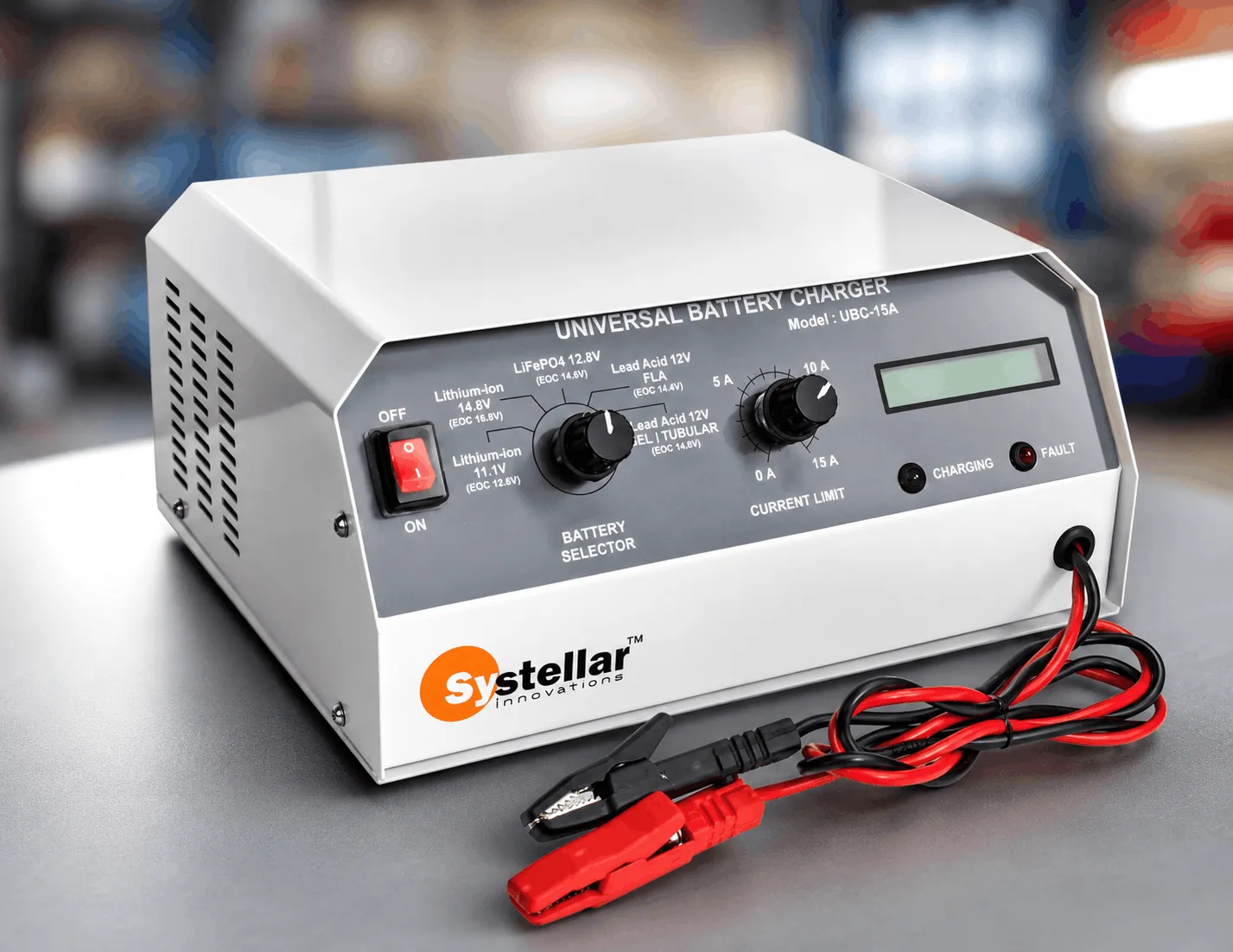
The reverse mistake is just as real: a lithium charger on a lead-acid battery skips the equalization and multi-stage charging that tubular batteries need, and they sulphate early. Chemistry-specific profiles are non-negotiable — which is exactly why the Systellar Universal Battery Charger has five selectable profiles instead of one compromise profile.
3. LiFePO4 vs lead acid: the real economics for Indian users
LiFePO4 costs roughly twice as much upfront. Whether it wins depends on cycles, not sticker price:
| Factor (typical 12V, 100Ah) | Tubular lead acid | LiFePO4 |
|---|---|---|
| Upfront price (2026, indicative) | ₹10,000–14,000 | ₹20,000–30,000 |
| Cycle life (80% DoD) | 400–800 cycles | 2,000–4,000 cycles |
| Usable capacity | ~50–60% (deep discharge shortens life) | ~80–90% |
| Maintenance | Water topping, terminal cleaning | None |
| Weight | ~28–32 kg | ~11–13 kg |
| Cost per delivered kWh over life | Higher | Typically 2–3× lower |
The verdict: for daily-cycling uses — solar systems, areas with regular power cuts, e-mobility — LiFePO4 is cheaper per unit of energy delivered, despite the higher price tag. For a backup battery that cycles a few times a month, tubular lead acid remains perfectly rational. Either way, correct charging is what actually delivers the rated cycle life. Upgrading an inverter to lithium? Read: Lithium battery charger for inverter.
4. C/10 vs C/20: how much current should you charge at?
The C-rate expresses charging current as a fraction of battery capacity:
| Rate | Current for 100Ah | Time to full | Use when |
|---|---|---|---|
| C/20 | 5A | ~20–24 hrs | Old, hot or sulphated lead acid; gentle maintenance charge |
| C/10 | 10A | ~10–12 hrs | Standard for tubular/flat-plate lead acid — the manufacturer's rated maximum |
| C/5–C/2 | 20–50A | ~2–5 hrs | LiFePO4 only — lithium tolerates fast charging that would cook lead acid |
Exceeding C/10 on a lead-acid battery causes gassing, heat and plate damage; that's why serious chargers have an adjustable current limit. On the UBC-15A you set the current on a dial (0–15A) — 10A for a 100Ah tubular, 15A for a 150Ah, full speed for lithium.
5. Deep-discharge recovery: can a flat battery be saved?
A battery left flat is the most common "dead battery" in India — the inverter beeped, nobody noticed, and the battery sat at 9V for a month. The prognosis:
- Lead acid: recoverable if caught within days–weeks. A deep-charging mode applies a small controlled current to raise the voltage before bulk charging begins. Left flat for months, the plates sulphate permanently and capacity is gone.
- LiFePO4: the BMS disconnects the pack below its cutoff, so many chargers read "no battery" and refuse to start. A charger with a recovery/wake-up mode gently raises the pack until the BMS reconnects. Packs driven far below 2.0V/cell (rare, usually from months of storage while flat) should be replaced.
The UBC's dedicated deep charging mode exists for exactly these cases — it is the difference between recovering a ₹12,000 battery and buying a new one. Prevention is cheaper still: recharge any battery promptly after a deep discharge, and never store a battery flat.
6. How to check if a 12V battery is fully charged (voltage chart)
Measure the rested voltage — disconnect the charger and any load, wait 2–4 hours, then read the terminals with a multimeter. Voltage measured during or right after charging reads artificially high.
| State of charge | Lead acid (rested) | LiFePO4 12.8V (rested) |
|---|---|---|
| 100% | 12.7–12.8V | 13.3–13.4V |
| 75% | ~12.4V | ~13.2V |
| 50% | ~12.2V | ~13.1V |
| 25% | ~12.0V | ~12.9V |
| Empty — recharge now | ≤11.8V | ≤12.0V |
Notice how flat the LiFePO4 column is — barely 0.3V separates 25% from 75%. A multimeter is a reliable fuel gauge for lead acid but a poor one for lithium; for LiFePO4 trust the BMS app or the charger's display (the UBC-15A's LCD shows live voltage, current and charge status) rather than voltage alone.
7. Charging in Indian summer heat: what changes above 40°C
Heat is the other great battery killer in India — every 10°C above 25°C roughly halves a lead-acid battery's service life, and charging adds its own heat on top. In peak summer:
- Charge in shade and ventilation — never in a closed metal cabinet or on a west-facing balcony at 4 PM. If the case is too hot to touch comfortably, pause and let it cool.
- Slow down — drop from C/10 toward C/20 on very hot days (on an adjustable charger, halve the current). Slower charging means less internal heating and less water loss.
- Top up flooded batteries — summer charging boils off water faster; check levels monthly and top up with distilled water only.
- LiFePO4 handles heat better — its thermal stability is a key reason it's replacing lead acid in Indian solar and inverter use, but its BMS will still (correctly) refuse to charge above ~55–60°C, so shade matters for lithium too.
- Summer grids sag — evening voltage in many towns dips well below 200V just when everyone charges. A wide-input charger (the UBC accepts 140–280V) keeps charging correctly through the sag instead of cutting out.