
Overview
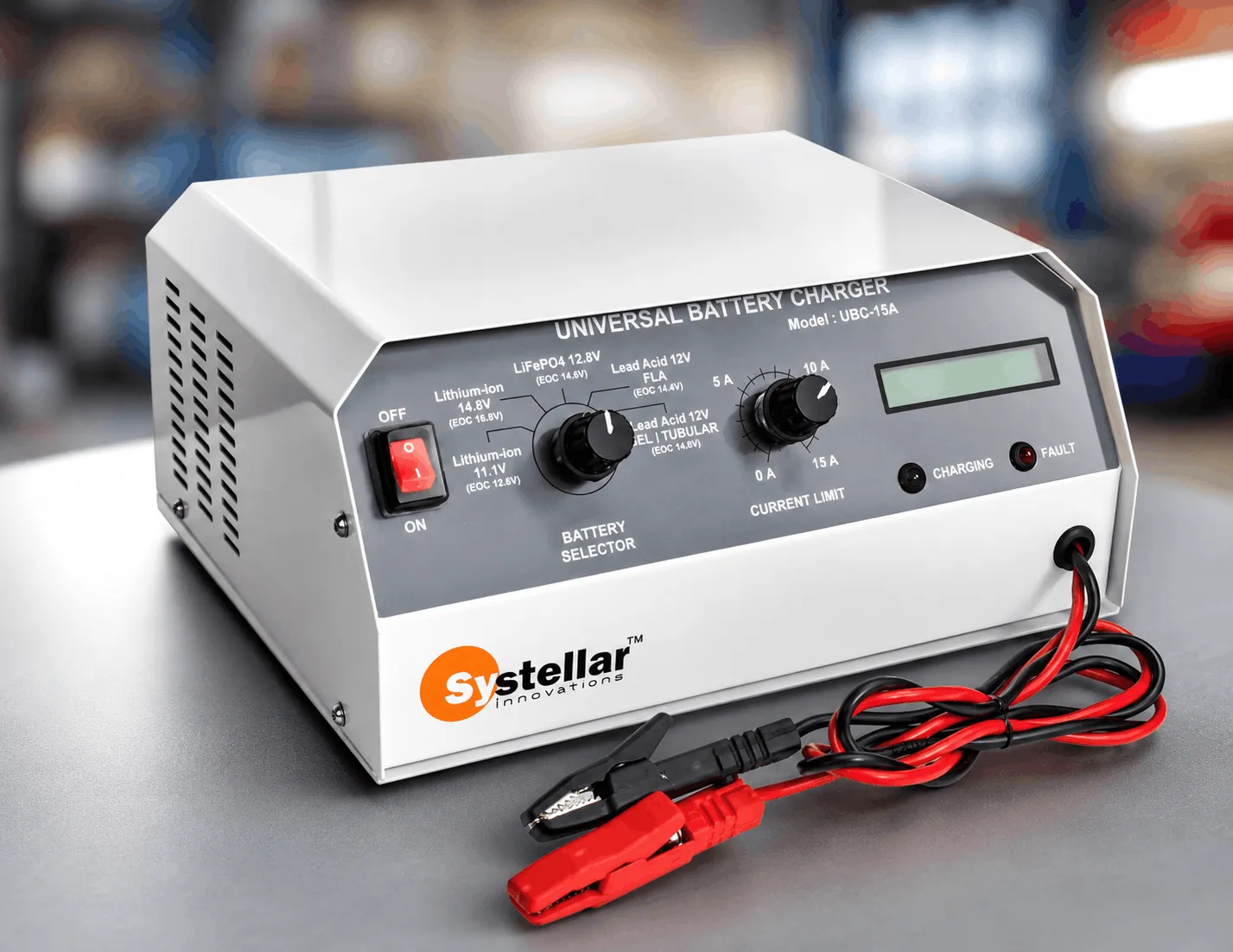
Systellar Innovations, only manufacturer in India offering a universal charger for all three chemistry, brings you the Universal Battery Charger (UBC). A groundbreaking, versatile charging solution designed to meet all your battery charging needs, no matter the type! As the only manufacturer in India offering a universal battery charger that can charge Lithium Ferro Phosphate (LiFePO4), Lithium-ion (Li-ion), and Lead Acid (Gel & FLA) batteries, we’re revolutionizing how you power up your devices. Whether it’s for your e-rickshaw battery bank, solar system, or inverter battery, the Universal Battery Charger guarantees fast, reliable, and accurate charging.
LiFePO4 Battery Charger 12V — That Also Charges Li-ion & Lead Acid Correctly
Most battery chargers in India are built for one battery type only. Use a standard lead acid charger on a LiFePO4 battery and you risk permanently damaging the cells — because LiFePO4 requires a higher end-of-charge voltage and a strict CC/CV (constant current / constant voltage) algorithm that most lead acid chargers simply don’t deliver. Use a lithium charger on a lead acid battery and you skip the equalization stage that keeps tubular and flat plate batteries healthy.
Systellar’s Universal Battery Charger (UBC) solves this problem completely. As the only manufacturer in India to offer a single charger that correctly charges LiFePO4, Lithium-ion, and Lead Acid batteries from one device, the UBC eliminates the need to own multiple chargers for different battery types. Select your battery chemistry on the front-panel switch, connect, and the microprocessor-controlled charging circuit delivers the exact voltage profile that battery requires — automatically.
Available in two models: UBC-5A (up to 5A charging current) and UBC-15A (adjustable up to 15A). Both are compact, high-frequency designs made in Meerut, Uttar Pradesh.
Application 1 — E-Rickshaw Battery Bank & EV Workshop Charging (12V Batteries)
E-Rickshaw Battery Charger — Charge Each 12V Battery Correctly, Made in India
India runs on more than 1.5 million e-rickshaws, and most lead-acid e-rickshaws build their 48V system from four 12V batteries connected in series. Charging the bank as one unit hides weak batteries: one under-performing 12V battery drags down the whole set and shortens the life of the other three. Workshops and fleet operators get far longer battery life by disconnecting and bench-charging each 12V battery individually — exactly what the UBC is built for.
The Systellar UBC is a purpose-built 12V bench charger for e-rickshaw batteries and EV workshops. It correctly charges every 12V battery type a workshop sees — flat plate, tubular/gel lead acid, and the 12V lithium packs used in low-speed EVs, conversion kits and battery-swap builds:
- Lead Acid Flat Plate & Tubular/Gel 12V (end-of-charge 14.4V / 14.8V) — the batteries inside most Indian e-rickshaw banks; the UBC's proper multi-stage profile with equalization keeps them healthy
- LiFePO4 12.8V packs (end-of-charge voltage 14.6V) — the safest, longest-lasting chemistry for 12V low-speed EVs, solar vehicles and conversion builds
- Li-ion 11.1V (3S) & 14.8V (4S) packs (end-of-charge 12.6V / 16.8V) — 12V-class lithium packs used in e-cycles, conversion kits and small EV projects
Honest note: mainstream electric scooters (Ola, Ather, Hero Electric, Okinawa etc.) use sealed 36V–72V packs with proprietary chargers — the UBC is a 12V charger and is not a replacement for those. It shines where batteries are 12V: e-rickshaw lead-acid banks charged one battery at a time, 12V lithium conversion packs, and workshop bench charging.
The UBC-15A model is particularly suited for workshop and fleet charging — at 15A it charges a 20Ah LiFePO4 pack in approximately 1.5 hours, and its adjustable current limit lets you set the correct C/10 rate for e-rickshaw lead-acid batteries (e.g. 10A for a 100Ah battery) or a gentler C/5 rate for older packs where battery health is a concern.
Who needs this: E-rickshaw workshops and mechanics bench-charging individual 12V batteries from 48V banks, fleet operators who rotate and equalize battery sets to extend life, EV conversion builders using 12V lithium packs, and battery dealers who need one charger compatible with every 12V chemistry that comes across the counter.
Application 2 — Solar System Maintenance Charging
Lithium Battery Charger for Inverter & Solar Backup — LiFePO4, Gel & Tubular
Every off-grid solar power system eventually needs its battery bank recharged from mains power — during a cloudy week, a long monsoon, or a system shutdown for maintenance. In these situations, most solar system owners are stuck: their MPPT charge controller only charges from solar panels, and a standard inverter charger may not support the lithium battery bank they’ve installed.
The Systellar UBC is a purpose-built solar system battery charger that works directly from AC mains (230V Indian supply) to charge the same batteries your solar system uses — without going through the inverter or the charge controller. It supports every battery chemistry used in Indian solar installations:
- LiFePO4 12.8V — the battery chemistry of choice for modern off-grid solar systems, solar street lights, and solar fans due to its 2,000+ cycle life and thermal stability in Indian heat
- Lead Acid Flat Plate 12V (end-of-charge 14.4V) — standard in budget off-grid home systems and small solar UPS setups
- Lead Acid Tubular / Gel 12V (end-of-charge 14.8V) — used in C10 tubular batteries found in most residential inverter backup systems in North India
For solar street light maintainers, the UBC-5A is a compact and portable option for topping up individual 12V battery modules removed from pole-mounted luminaries for bench charging. For home solar backup systems with 100Ah–150Ah tubular batteries, the UBC-15A’s adjustable current limiter allows you to set charging current within the C/10 rating typically specified by tubular battery manufacturers.
Who needs this: Solar system integrators and maintenance engineers servicing off-grid installations, homeowners with solar backup systems who need a standalone charger during low-solar periods, solar street light maintenance contractors, and anyone commissioning a new lithium solar battery bank who needs to pre-charge cells before first use.
Key Features:
- Multi-Compatibility: Supports Li-ion, LiFePO4, and Lead Acid (Gel & FLA) batteries.
- Perfect for Multiple Applications: Ideal for charging 12V batteries of e-rickshaws (one battery at a time), solar street lights, solar fans, home lighting systems, inverters, power backup equipment, and more!
- User-Friendly: Simply select your battery type, and let the charger do the rest. Effortless charging with precision.
- Microprocessor-Based Design: Offers high-frequency, compact design for maximum portability and efficiency.
Model Options:
- UBC-5A: Maximum charging current of 5A.
- UBC-15A: Maximum charging current of 15A, offering advanced features like an LCD display to show battery voltage, charging current, and status. – Buy on Amazon →
Buy the Universal Battery Charger online
Order factory-direct from the manufacturer in Meerut, with a proper GST invoice and pan-India shipping. Buy online in a few clicks from our Systellar store:
Need bulk, workshop or fleet pricing? WhatsApp us, call +91 95680 04455 or send an enquiry for a quote within 24 hours.
Charging Compatibility:
- Li-ion Battery Pack 11.1V (End voltage 12.6V)
- Li-ion Battery Pack 14.8V (End voltage 16.8V)
- LiFePO4 Battery Pack 12.8V (End voltage 14.6V)
- Lead Acid (Flat Plate) 12V (End voltage 14.4V)
- Lead Acid (Gel/Tubular) 12V (End voltage 14.8V)
Every profile above is for a 12 volt nominal bank, apart from the 14.8V setting, which is a 4-series lithium-ion pack charged from the same unit. The reason one charger can cover all of them safely is that the end-of-charge voltage changes with the chemistry — and that single number is what decides whether a charger preserves a pack or slowly destroys it. A 12 volt LiFePO4 battery is full at 14.6V; a flat-plate lead-acid battery of the same nominal voltage needs 14.4V; a gel or tubular battery needs 14.8V. Put a lead-acid charger on a lithium pack and it keeps pushing voltage past the point the cells can accept, until the BMS disconnects. Put a fixed 12.6V lithium-ion charger on a LiFePO4 pack and it will never reach full capacity.
Which profile should I select?
| Battery you have | Profile to select | Charger stops at |
|---|---|---|
| 12 volt LiFePO4 (LFP), 4 cells in series — solar, inverter, e-rickshaw | LiFePO4 12.8V | 14.6V |
| 12 volt lithium ion (li-ion) pack, 3 cells in series | Li-ion 11.1V | 12.6V |
| Lithium ion pack, 4 cells in series (14.8V nominal) | Li-ion 14.8V | 16.8V |
| 12 volt flat-plate / flooded lead acid | Lead Acid (Flat Plate) | 14.4V |
| 12 volt gel or tubular lead acid — inverter batteries | Lead Acid (Gel/Tubular) | 14.8V |
If you are unsure which chemistry you have, the label on the battery states it. When the battery is lithium, the pack’s nominal voltage (11.1V, 12.8V or 14.8V) tells you the profile — not the “12V” printed on the equipment it powers.
Why Choose the Universal Battery Charger?
- 100% Made In India: Designed and manufactured for Indian conditions.
- Charging current adjustable: In the UBC-15A model, set your maximum charging current for more control.
- Safety Features: Equipped with surge protection (4KV) and insulated battery clamps to prevent short circuits.
- Accurate and Efficient Charging: Features active power factor correction, 3-stage battery charging for lead acid, and precise end-of-charge voltage for battery protection.
- Wide Voltage Range: Can operate in an AC input voltage range of 140V–280V (50Hz), making it suitable for diverse environments.
- Durable Design: Built for long-lasting performance with rugged construction and exceptional reliability.
UBC vs Ordinary Lead-Acid Charger vs Cheap Lithium Charger
| Feature | Systellar UBC | Ordinary lead-acid charger | Cheap lithium charger |
|---|---|---|---|
| Chemistries supported | LiFePO4, Li-ion (3S/4S) & Lead Acid (FLA/Gel/Tubular) | Lead acid only | One lithium pack voltage only |
| CC/CV charging algorithm | Yes — microprocessor-controlled, per chemistry | No — crude taper charging | Basic, often no true CV cutoff |
| Safe for LiFePO4? | Yes — exact 14.6V end-of-charge | No — equalization voltage can damage cells | Only if voltage matches exactly |
| 3-stage lead-acid charging | Yes | Sometimes | No |
| Surge protection | 4KV, wide 140–280V AC input | Rare | Rare |
| Adjustable charging current | Yes (UBC-15A, up to 15A) | No | No |
| Made in India, 1-yr warranty | Yes — ISO 9001:2015 factory, Meerut | Varies | Usually imported, no support |
Get the Best Performance from Your Batteries!
The Universal Battery Charger from Systellar Innovations is your ultimate solution for efficient and reliable charging. No more worries about compatibility issues – whether you need to charge a Lithium-ion, LiFePO4, or Lead Acid battery, our charger adapts to your needs and ensures your battery gets the best charge every time.
The UBC is available to buy on Amazon.in (search “Systellar Universal Battery Charger”). For bulk orders (workshop, fleet, distributor pricing), call our Meerut office at +91-9568004455. Contact us today to learn more about how our Made in India Universal Battery Charger can power up your devices, from electric vehicles to solar systems and more!
Technical Specifications
| Parameters | Universal Battery Charger – 5A | Universal Battery Charger – 15A |
|---|---|---|
| Model: UBC-5A | Model: UBC-15A | |
| AC Input Voltage Range | 140V – 280V | |
| Battery types that can be charged | 12.8V Lithium Ferro Phosphate (LiFePO4) battery | |
| 11.1V Lithium-ion (Li-ion) battery | ||
| 14.8V Lithium-ion (Li-ion) battery | ||
| 12V Lead Acid – Flat Cell (FLA) battery | ||
| 12V Lead Acid – Gel battery | ||
| Battery Charging current | 5A fixed | Selectable from 0A – 15A |
| Battery Charging modes | Deep charging mode (For deep discharged battery) | |
| Bulk charging mode | ||
| Absorption charging mode | ||
| Trickle charging mode | ||
| LCD display | No | Yes |
| Displays Battery Voltage, Battery charging current, Battery status | ||
| LED Indication | Green LED – Charging indication | |
| Red LED – Fault | ||
| Active PFC | Yes | Yes |
| Power Factor | > 0.95 | > 0.95 |
| Protections | Battery reverse terminal protection, Short-circuit protection, Battery overcharge protection | |
| Surge protection | 4 KV (Differential and common mode) | |
| Inline protection | 4A Glass fuse | |
| Cooling | Natural / Forced cooling | |
| Battery charging cable length | 1 metre | |
| Warranty | 1 year manufacturer warranty | |
| Certification | ISO 9001:2015 (company-wide) · Made in India | |
Frequently Asked Questions (FAQ)
What is a universal battery charger and why do I need one?
A standard battery charger is built for one chemistry only — a lead-acid charger cannot safely charge a LiFePO4 battery, and a lithium charger skips the equalization stage that lead-acid batteries need to stay healthy.
The Systellar Universal Battery Charger (UBC) replaces all three. It is a microprocessor-controlled, 5-in-1 charger that delivers the correct charging algorithm for your selected battery type — CC/CV for lithium chemistries, multi-stage for lead acid — from a single compact device. One charger for every 12V battery you own.
Which battery types does the Systellar UBC support?
The UBC supports five battery configurations from a single device:
- LiFePO4 12.8V — end-of-charge 14.6V. Solar street lights, off-grid solar, low-speed EVs, inverter upgrades.
- Li-ion 11.1V (3-cell) — end-of-charge 12.6V. E-cycles, conversion kits, solar fans, home lighting.
- Li-ion 14.8V (4-cell) — end-of-charge 16.8V. Cargo cycles, small EV projects, power backup.
- Lead Acid Flat Plate 12V — end-of-charge 14.4V. Two-wheelers, small solar UPS, inverters.
- Lead Acid Tubular / Gel 12V — end-of-charge 14.8V. C10 tubular batteries in home inverter systems.
Select the battery type using the front-panel switch, connect the clamps, and the UBC delivers the correct profile automatically.
Why can’t I just use a regular lead-acid charger on my LiFePO4 battery?
A standard lead-acid charger will damage a LiFePO4 battery for three reasons. First, its equalization mode periodically applies a high voltage (15V+) to balance cells — LiFePO4 cells cannot tolerate this and suffer irreversible damage.
Second, the lead-acid float voltage (13.3–13.8V) is too low a trigger for LiFePO4: the charger reads a healthy, partially discharged pack as nearly empty and begins overcharging it. Third, the end-of-charge voltage differs — LiFePO4 needs exactly 14.6V, while lead-acid chargers top out at 14.4V (flat plate) or 14.8V (tubular).
The UBC eliminates this by giving each battery type its own precisely controlled profile, with no risk of cross-chemistry damage.
Can I use this charger for my electric scooter or e-rickshaw battery?
It depends on the battery voltage. Mainstream electric scooters (Ola, Ather, Hero Electric, Okinawa etc.) use sealed 36V–72V packs — the UBC is a 12V charger and cannot charge those.
For e-rickshaws the answer is usually yes: most lead-acid e-rickshaws use four 12V batteries in series, and the UBC is ideal for disconnecting and bench-charging each 12V battery individually — the best way to spot weak batteries and extend the life of the whole bank. It also charges the 12V lithium packs (LiFePO4 12.8V, Li-ion 3S/4S) used in e-cycles, conversion kits and low-speed EV builds.
Is this charger suitable for charging solar system batteries?
Yes. Solar owners and installers use the UBC as a standalone AC-mains charger for solar batteries. During extended cloudy periods, monsoon weeks or maintenance shutdowns, it recharges your battery bank directly from a 230V supply — without routing through the inverter or the solar charge controller.
It supports all chemistries used in Indian solar installations: LiFePO4 (preferred for modern off-grid systems), Lead Acid Flat Plate, and Tubular/Gel. Solar street-light contractors also use the UBC-5A as a portable bench charger for individual 12V modules.
What is the difference between the UBC-5A and UBC-15A models?
Both support all five battery types. The difference is charging speed and current control. UBC-5A — max 5A; compact, ideal for smaller packs (up to ~20–30Ah), portable maintenance charging and solar street-light batteries. UBC-15A — max 15A, adjustable; faster for larger packs (20–100Ah).
The adjustable current matters for Lead Acid tubular batteries, typically rated at C/10 — a 100Ah tubular should be charged at no more than 10A, which the UBC-15A lets you set precisely. If unsure, the UBC-15A is the more versatile choice: it can charge at 5A or lower, but the UBC-5A cannot exceed 5A.
Is the charging fast and safe?
Yes. The microprocessor-controlled charging circuit delivers accurate constant-current / constant-voltage (CC/CV) charging tuned to the selected chemistry, for fast charging without overcharging or damaging the cells.
Is this a 12 volt lithium ion battery charger?
Yes — and it is a LiFePO4 charger and a lead-acid charger in the same unit, because you select the chemistry before connecting the battery. For lithium ion (li-ion) packs there are two profiles: 11.1V nominal, which is three cells in series and ends at 12.6V, and 14.8V nominal, which is four cells and ends at 16.8V. For a 12.8V LiFePO4 pack it ends at exactly 14.6V. Since the end-of-charge voltage is set per chemistry rather than fixed, one 12 volt charger covers lithium ion, LiFePO4 and lead acid safely.
What voltage should a 12V LiFePO4 charger stop at?
14.6V. A 12 volt LiFePO4 battery is four LFP cells in series, and each cell is full at about 3.65V, so the pack is full at 14.6V. Push past that and you stress the cells and will usually trip the BMS into disconnecting; stop short of it and you leave usable capacity unused, which is the common complaint when people charge LiFePO4 from a generic lithium charger set for 12.6V. The UBC’s LiFePO4 profile ends at exactly 14.6V.
Can one charger handle both 12 volt lithium and lead acid batteries?
Only if both the end-of-charge voltage and the charging curve change with the chemistry — which is what the UBC does and what a single-profile charger cannot. Lead acid gets 3-stage charging (bulk, absorption, then a float stage that holds the battery topped up). Lithium gets CC/CV with a hard cut-off and no float stage, because holding a lithium pack at float voltage is harmful rather than helpful. A charger that applies one curve to both chemistries is unsafe on at least one of them.
Note: product specifications are subject to change for continuous product enhancement. Please contact Systellar for the latest specifications.