
Inverter Battery Charger — Charge 12V LiFePO4 (and Tubular) Batteries Correctly
Why your inverter can't charge a lithium battery properly
A standard Indian home inverter charges its battery with a lead-acid algorithm. Three things go wrong when a LiFePO4 pack is connected:
- Wrong end-of-charge voltage. Lead-acid chargers stop at 14.4V (flat plate) or push to 14.8V (tubular). LiFePO4 needs exactly 14.6V — lower means the pack never fills; higher stresses the cells.
- Equalization. Many inverters periodically apply 15V+ to desulphate lead-acid plates. LiFePO4 cells cannot tolerate this and suffer irreversible damage — this is the single fastest way to ruin a lithium pack.
- Float-voltage confusion. A lead-acid float of 13.3–13.8V reads a healthy, partially-charged lithium pack as nearly empty and keeps pushing charge into it.
Some newer inverters ship with a genuine lithium mode — if yours does, use it. If not (or if you're unsure), the safe route is an external charger with a true LiFePO4 profile.
The fix: a mains charger with a real LiFePO4 profile
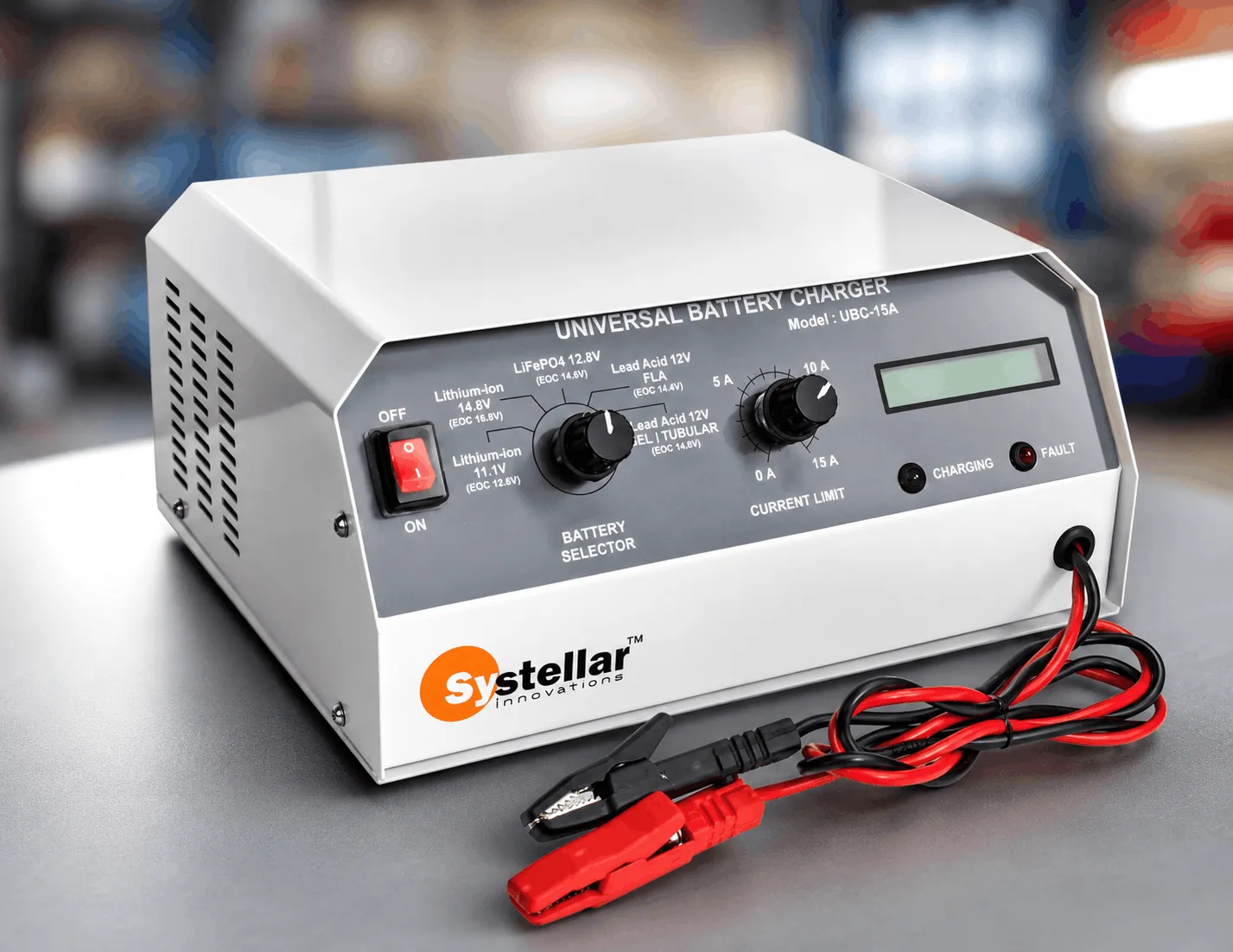
The Systellar Universal Battery Charger (UBC) plugs into any 230V socket (it tolerates 140–280V AC — useful on weak rural grids) and delivers a microprocessor-controlled CC/CV charge tuned to the exact chemistry you select on the front panel:
| Your inverter battery | UBC profile | End-of-charge | Recommended current |
|---|---|---|---|
| LiFePO4 12.8V (new lithium upgrade) | LiFePO4 | 14.6V exact | Up to 15A (100Ah pack ≈ 7–8 hrs) |
| Tubular 12V, 100–150Ah (existing) | Lead Acid Tubular/Gel | 14.8V, multi-stage | C/10 → 10–15A, set on the dial |
| Flat plate 12V (small backup) | Lead Acid Flat Plate | 14.4V, multi-stage | C/10 → typically 5–10A |
That last column matters: tubular battery manufacturers specify a C/10 maximum charging rate. The UBC-15A's adjustable 0–15A limit lets you set exactly 10A for a 100Ah battery or 15A for a 150Ah battery — something fixed-current chargers cannot do.
Will a lithium battery work with my existing inverter at all?
Charging is the tricky half — the discharging half (inverter drawing power from the battery) usually works fine, with three checks:
- Discharge current rating. The pack's BMS must handle the inverter's maximum draw. A 900VA inverter can pull roughly 75–90A from a 12V battery at full load — check the BMS continuous-discharge rating on the lithium pack's datasheet before buying (100A BMS is common on inverter-grade 100Ah packs).
- Low-voltage cutoff. Most inverters cut off around 10.5V, which is safely above LiFePO4's danger zone — and the pack's own BMS protects it regardless. No modification needed.
- The fuel gauge will lie. Inverter battery indicators estimate charge from voltage, and LiFePO4's voltage curve is almost flat from 20% to 90% — so the display may show "full" for days and then drop suddenly. The battery is fine; the gauge is calibrated for lead acid.
100Ah or 150Ah LiFePO4? A quick sizing check
Backup time ≈ (Ah × 12.8V × 0.9 usable) ÷ load in watts. For typical Indian power-cut loads (fans, lights, router, TV ≈ 300W):
| Battery | Backup @ 300W load | Backup @ 500W load | Recharge time (UBC-15A) |
|---|---|---|---|
| 100Ah LiFePO4 | ~3.8 hrs | ~2.3 hrs | ~7–8 hrs |
| 150Ah LiFePO4 | ~5.7 hrs | ~3.4 hrs | ~11–12 hrs |
| 150Ah tubular (for comparison) | ~3.2 hrs* | ~1.9 hrs* | ~12 hrs at C/10 |
*Tubular figures assume ~55% usable capacity — discharging lead acid deeper than that on a daily basis shortens its life sharply, which is why a 100Ah lithium pack often replaces a 150Ah tubular one-for-one.
When you'll actually use it
- Commissioning a new lithium pack — pre-charge fully and verify the pack before connecting it to the inverter.
- After long power cuts or deep discharge — the UBC's deep-charging mode safely recovers a deeply discharged battery that the inverter refuses to charge.
- During inverter downtime or servicing — keep the battery healthy while the inverter is away.
- Solar backup homes — during monsoon weeks, charge the bank directly from mains without routing through the solar charge controller.
- Running two battery types — one charger correctly serves the new lithium pack and the old tubular battery you moved to a second inverter.
Safety, in brief
Switch the inverter off (or disconnect the battery) while charging externally so the two chargers don't work against each other. The UBC adds its own protection layer: reverse-polarity protection, short-circuit protection, overcharge protection, 4KV surge protection and insulated clamps. It is designed and manufactured in Meerut by Systellar Innovations (ISO 9001:2015, founded by IIT alumni) with a 1-year manufacturer warranty honoured in-house.
Where to buy the UBC-15A — Amazon.in or the Systellar store
The UBC-15A is sold through two channels — same unit, same 1-year manufacturer warranty, no middlemen or resellers in between. Choose whichever is more convenient:
🚚 Whichever you choose, your charger is dispatched directly from the Systellar factory in Meerut. Amazon and the Systellar Store are just two doors to the same factory-fresh stock.
For bulk or distributor pricing, call +91 95680 04455 or WhatsApp us.